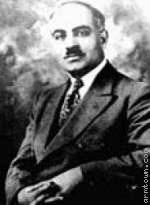
Ambassador Morgenthau Excerpts
The Central Government now announced its intention of gathering the two million or more Armenians living in the several sections of the empire and transporting them to this desolate and inhospitable region [the Syrian desert]… The real purpose of the deportation was robbery and destruction; it really represented a new method of massacre. When the Turkish authorities gave the orders for these deportations, they were merely giving the death warrant to a whole race; they understood this well, and, in their conversations with me, they made no particular attempt to conceal the fact.
All through the spring and summer of 1915 the deportations took place. Scarcely a single Armenian, whatever his education or wealth, or whatever the social class to which he belonged, was exempted from the order…
Scarcely had the former possessors left the village, when Mohammedan mohadjirs - immigrants from other parts of Turkey - would be moved into the Armenian quarters. Similarly all their valuables… [were] then parceled out among the Turks.
Before the caravans were started, it became the regular practice to separate the young men from the families, tie them together in groups of four, lead them to the outskirts, and shoot them. Public hangings without trial - the only offense being that the victims were Armenians - were taking place constantly. The [soldiers] showed a particular desire to annihilate the educated and the influential… I was constantly receiving reports... [of Armenian men marched to a] secluded valley, a mob of Turkish peasants fell upon them with clubs, hammers, axes, scythes, spades, and saws.
A guard of [soldiers] accompanied each convoy… From thousands of Armenian cities and villages these despairing caravans now set forth; they filled all the roads leading southward… When the caravans first started, the individuals bore some resemblance to human beings; in a few hours, however, the dust of the road plastered their faces and clothes, the mud caked their lower members, and the slowly advancing mobs, frequently bent with fatigue and crazed by the brutality of their "protectors," resembled some new and strange animal species. Yet for the better part of six months, from April to October 1915, practically all the highways in Asia Minor were crowded with these unearthly bands of exiles. They could be seen winding in and out of every valley and climbing up the sides of nearly every mountain - moving on and on… every road led to death. Village after village and town after town was evacuated of its Armenian population… about 1,200,000 people started on this journey to the Syrian desert.
Detachments of [soldiers] would go ahead, notifying the Kurdish tribes that their victims were approaching, and Turkish peasants were also informed that their long-waited opportunity had arrived. The Government even opened the prisons and set free the convicts… Thus every caravan had a continuous battle for existence… Turkish roughs would fall upon the women, leaving them sometimes dead from their experiences or sometimes ravingly insane.
And thus, as the exiles moved, they left behind them another caravan - that of dead and unburied bodies, of old men and of women dying in the last stages of typhus, dysentery, and cholera, of little children lying on their backs and setting up their last piteous wails for food and water.
The most terrible scenes took place at the rivers, especially the Euphrates. Sometimes, when crossing this stream, the gendarmes would push the women into the water, shooting all who attempted to save themselves by swimming. Frequently the women themselves would save their honor by jumping into the river, their children in their arms… In a loop of the river near Erzinghan… the thousands of dead bodies created such a barrage that the Euphrates changed its course for about a hundred yards.
At another place, where there were wells, some women threw themselves into them… [and] were drowned and, in spite of that, the rest of the people drank from that well, the dead bodies still remaining there and polluting the water.
In one particular death march… On the seventieth day a few creatures reached Aleppo. Out of the consigned convoy of 18,000 souls just 150 women and children reached the destination. A few of the rest… were still living as captives of the Kurds and Truks; all the rest were dead.
I have no means told the most terrible details…
Whatever crimes the most perverted instincts of the human mind can devise, and whatever refinements of persecution and injustice the most debased imagination can conceive, became the daily misfortunes of this devoted people. I am confident that the whole history of the human race contains no such horrible episode as this.
http://www.teachgenocide.org/background/ambassador.htm
Thursday, April 24, 2008

Hitler and the Armenian Genocide
Hitler and the Armenian Genocide
The Armenian Genocide was one of the most compelling human rights crises of World War I, helping to inspire Adolf Hitler three decades later to carry out the atrocities of World War II. Hitler's quote is still relevant today because the forces of denial and revisionism are still striving to expunge from history the record of this enormous crime against humanity - the first modern genocide of the 20th century.It is only through learning and remembering past atrocities that we are able to work toward their prevention and become a more humane society.
* * * *
On August 22, 1939, in preparation for the impending invasion of Poland, Hitler stated to Reichmarshal Hermann Goering and the commanding generals at Obersalzberg...
"Our strength consists in our speed and in our brutality. Genghis Khan led millions of women and children to slaughter - with premeditation and a happy heart. History sees in him solely the founder of a state. It's a matter of indifference to me what a weak western European civilization will say about me.
I have issued the command - and I'll have anybody who utters but one word of criticism executed by a firing squad - that our war aim does not consist in reaching certain lines, but in the physical destruction of the enemy. Accordingly, I have placed my death-head formations in readiness - for the present only in the East - with orders to them to send to death mercilessly and without compassion, men, women, and children of Polish derivation and language. Only thus shall we gain the living space (lebensraum) which we need. Who, after all, speaks today of the annihilation of the Armenians?"
This quote is the English version of the German document handed to Louis P. Lochner in Berlin. It first appeared in Lochner's What About Germany? (New York: Dodd, Mead & Co., 1942), pp. 1-4. The Nuremberg Tribunal later identified the document as L-3 or Exhibit USA-28. Two other versions of the same document appear in Appendices II and III. For the German original cf. Akten zur Deutschen Auswartigen Politik 1918-1945, Serie D, Band VII, (Baden-Baden, 1956), pp. 171-172.
http://www.teachgenocide.org/background/hitler.htm
Tuesday, April 22, 2008
Armenian Genocide
Armenian Genocide
http://video.google.com/videoplay?docid=1440139225140882066
Special Thanks to the Author of the Video Heghine A' Daniel
Turkey and its Christians
The cross and the crescent
Why Christians feel under threat in today's Turkey
THIS has been a bad year for Orhan Picaklar. As a Protestant missionary in Samsun, on the Black Sea, he has had death threats and his church has been repeatedly stoned. Local newspapers called him a foreign agent. A group of youths tried to kidnap him as he was driving home. His pleas for police protection have gone unheeded.
Mr Picaklar is not alone. All over Turkey, Christians are under attack. In January Hrant Dink, an ethnic Armenian newspaper editor, was shot dead in Istanbul by a teenager who said he had “insulted Turkishness”. In April two Turks and a German, all evangelists, were murdered in Malatya. Their killers bound and tortured them before slitting their throats. In December an Italian Catholic priest was knifed by a teenager in Izmir. Another Italian priest was shot dead in Trabzon in 2006.
Many blame the attacks on a new ultra-nationalism, tinged with Islamic militancy, that has swept across Turkey. Unemployed teenagers in the Black Sea region seem especially prone to it. “The plight of Christians is critical,” says Husnu Ondul, president of the Ankara-based Turkish Human Rights Association. Like many others, he believes that the “deep state”, comprising a few judges, army officers and security officials who need enemies to justify their grip on power, is behind the attacks.
That may seem far-fetched. Yet evidence leaked to the media in the Dink and Malatya cases points to collusion between the perpetrators and rogue elements in the police and the army. It also suggests that the Istanbul police were tipped off about Mr Dink's murder a year before it was carried out. “So why did the Istanbul police do nothing to prevent it?” wonders Ergin Cinmen, a lawyer for the Dink family.
Respecting the religious freedom of non-Muslims is essential to Turkey's hopes of joining the European Union. Laws against Christians repairing their churches have been relaxed. Overriding objections from pious constituents, the ruling Justice and Development (AK) party has just restored an ancient Armenian church in eastern Turkey. School textbooks are being purged of an anti-Western bias.
Yet many Christian grievances remain. The prime minister, Recep Tayyip Erdogan, resists calls to reopen the Greek Orthodox Halki seminary on Heybeli island off Istanbul, shut down in 1971. Turkey refuses to recognise the ecumenical title of the Greek Orthodox patriarch, Bartholomew I, the spiritual leader of over 200m Orthodox Christians. The patriarch, a loyal Turkish citizen, has lobbied hard for Turkey's EU membership. But this has only reinforced suspicions among ultra-nationalist detractors, who accuse him of trying to “Christianise” Turkey and wanting a Vatican-style state in the heart of Istanbul.
Never mind that the Greek Orthodox church in Istanbul has dwindled to 4,000 souls, many of them too old to follow their children abroad. Nor that the patriarch must under Turkish law be a Turkish citizen, a rule which is making it difficult to find a successor to Bartholomew I. “They [ie, the Turks] apparently won't regard the conquest of Constantinople as complete until the patriarchate ceases to exist and all Christians have been frightened away,” suggests one restorer of icons in Istanbul.
The government has yet to approve a draft bill to help non-Muslims recover thousands of properties that have been confiscated by the state and either sold or left to decay. The Aya Yorgi church in Istanbul's Edirnekapi district, which was badly damaged in an earthquake, is one sad example. Its walls are cracked, its roof is leaking; a marble angel lies in pieces on the floor. “All we ask is to be permitted to rescue our church, but we cannot hammer a single nail,” complains Bishop Dionysios, a Greek Orthodox prelate who still conducts services there.
Many Christians concede that AK has treated them better than its secular predecessors did. They blame the deep state for their recent troubles. But the excuse of the deep state's power is wearing thin after AK's big victory in July's general election. “With such a strong mandate, the government's failure to meet our demands can only mean one thing, that the deep state is still in charge,” says a Christian priest. Or perhaps that AK believes in religious freedom for Muslims, but not Christians.
Dec 19th 2007 | ISTANBUL
http://www.economist.com/world/europe/displaystory.cfm?story_id=10337900
Monday, April 21, 2008
Case Study:The Armenian Genocide 1915-1917
Case Study:The Armenian Genocide 1915-1917
Summary
The Armenian genocide was one of the most massive "root-and-branch" exterminations ever carried out against a defenseless people. In 1915, as World War I raged, the Turkish government (ruler of the Ottoman Empire) decided upon the systematic extermination of most of the male Armenian population, and the forced deportation of the remainder, mostly women, children, and the elderly. The deportation became a death march, with extreme violence and deprivation leading to the death of most of the survivors of the initial gendercide -- as was intended. By the time the exhausted and traumatized survivors reached refuge in neighbouring countries, up to three-quarters of the entire Ottoman Armenian population had been exterminated.
The background
Armenians are one of the most ancient peoples of the Near East, having lived in the southern Caucasus region for as long as 3,000 years. Christianized early in the first millennium, they formed by the 19th century the largest non-Muslim population in the Ottoman Empire. Peaceful relations between Armenians and Ottoman Muslims had long been the norm: despite acts of discrimination, Armenians were referred to as "the loyal millet." This changed in the 19th century, as the forces of nationalism swept both the Ottoman realm and Armenians themselves, and as the Ottoman Empire -- "the sick man of Europe" -- began to crumble in the face of regional revolts. Calls by European powers for protection of the Armenian population had the opposite effect: the regime of Sultan Abdul Hamid II viewed such outside "intervention" as a threat to its sovereignty, and responded in 1896 with a massive campaign of killing, in which at least 200,000 Armenians died. Though one of the most atrocious imperial acts of the 19th century, it was merely a harbinger of the fullscale genocide that was to descend two decades later.
In 1908, a group of modernization-minded officers -- "the Young Turks" -- toppled the Ottoman Sultan. Armenians generally welcomed the new regime, viewing it as a progressive alternative to Ottoman despotism. But the "Young Turk" movement (with its political party, the Committee of Union and Progress [CUP]) was rapidly taken over by a small group of fanatical nationalists, headed by the triumvirate of Enver Pasha, Cemal Pasha, and Talat Pasha. The trio began to plot the extermination of the Armenian population, seen as a potentially traitorous "fifth column."
The events of World War I, which saw Turkey allied with Germany and Austria-Hungary against Britain, France, and Russia, gave these architects of genocide the opportunity they sought to implement their plan. One of the movement's leading ideologues, Dr. Nazim, told a closed session of the CUP Central Committee in February 1915 that "if this purge is not general and final, it will inevitably lead to problems. Therefore it is absolutely necessary to eliminate the Armenian people in its entirety, so that there is no further Armenian on this earth and the very concept of Armenia is extinguished. We are now at war. We shall never have a more suitable opportunity than this." (Quoted in G.S. Graber, Caravans to Oblivion: The Armenian Genocide, 1915, pp. 87-88.)
The slaughter began on April 24, 1915, with a classic act of "elitocide": some 600 Armenian notables, all male, were rounded up in Istanbul and murdered. Today, April 24 is commemorated by Armenians worldwide as "Genocide Memorial Day." Much worse was to come.
The gendercide against Armenian men
Like the Jewish holocaust, the Armenian genocide represents a case of a clear-cut, "pre-emptive" targeting of the male population, followed by a "root-and-branch" extermination of as many of the survivors as could be killed outright or driven to death. The two gendercidal strategies followed at the outset were 1) the mobilization of "battle-age" Armenian men for service in the Turkish army, followed by the execution or death through overwork of some hundreds of thousands of them; and 2) the concomitant rounding-up and mass slaughter of remaining community males. The U.S. Ambassador to Turkey, Henry Morgenthau, provided one of the most gut-wrenching descriptions of "The Murder of a Nation" in a report to his superiors, published after the war (the U.S. was at the time neutral in the conflict). He summarized the first strategy as follows:
In the early part of 1915, the Armenian soldiers in the Turkish army were reduced to a new status. Up to that time most of them had been combatants, but now they were all stripped of their arms and transformed into workmen. Instead of serving their country as artillerymen and cavalrymen, these former soldiers now discovered that they had been transformed into road labourers and pack animals. Army supplies of all kinds were loaded on their backs, and, stumbling under the burdens and driven by the whips and bayonets of the Turks, they were forced to drag their weary bodies into the mountains of the Caucasus. Sometimes they would have to plough their way, burdened in this fashion, almost waist high through snow. They had to spend practically all their time in the open, sleeping on the bare ground -- whenever the ceaseless prodding of their taskmasters gave them an occasional opportunity to sleep. They were given only scraps of food; if they fell sick they were left where they had dropped, their Turkish oppressors perhaps stopping long enough to rob them of all their possessions -- even of their clothes. If any stragglers succeeded in reaching their destinations, they were not infrequently massacred. In many instances Armenian soldiers were disposed of in even more summary fashion, for it now became almost the general practice to shoot them in cold blood. In almost all cases the procedure was the same. Here and there squads of 50 or 100 men would be taken, bound together in groups of four, and then marched out to a secluded spot a short distance from the village. Suddenly the sound of rifle shots would fill the air, and the Turkish soldiers who had acted as the escort would sullenly return to camp. Those sent to bury the bodies would find them almost invariably stark naked, for, as usual, the Turks had stolen all their clothes. In cases that came to my attention, the murderers had added a refinement to their victims' sufferings by compelling them to dig their graves before being shot.
Morgenthau describes one such episode in July 1915, in which some 2,000 Armenian "amйlйs" ("such is the Turkish word for soldiers who have been reduced to workmen") were dispatched from the city of Harpoot, ostensibly for a road-construction project:
The Armenians in that town understood what this meant and pleaded with the Governor for mercy. But this official insisted that the men were not to be harmed, and he even called upon the German missionary, Mr. Ehemann, to quiet the panic, giving that gentleman his word of honour that the ex-soldiers would be protected. Mr. Ehemann believed the Governor and assuaged the popular fear. Yet practically every man of these 2,000 was massacred, and his body thrown into a cave. A few escaped, and it was from these that news of the massacre reached the world. A few days afterward another 2,000 soldiers were sent to Diarbekir. The only purpose of sending these men out in the open country was that they might be massacred. In order that they might have no strength to resist or to escape by flight, these poor creatures were systematically starved. Government agents went ahead on the road, notifying the Kurds that the caravan was approaching and ordering them to do their congenial duty. Not only did the Kurdish tribesmen pour down from the mountains upon this starved and weakened regiment, but the Kurdish women came with butcher's knives in order that they might gain that merit in Allah's eyes that comes from killing a Christian. These massacres were not isolated happenings; I could detail many more episodes just as horrible as the one related above ...
Like the opening "elitocide," this strategy was designed to strip the Armenian community of those who might effectively mobilize and defend it, as Morgenthau notes: "Throughout the Turkish Empire a systematic attempt was made to kill all able-bodied men, not only for the purpose of removing all males who might propagate a new generation of Armenians, but for the purpose of rendering the weaker part of the population an easy prey." A prominent modern scholar of the genocide, Vahakn Dadrian, concurs: "Though [the] mobilization had many other objectives, it served a major purpose for the swift execution of the plan of genocide. By removing all able-bodied Armenian males from their cities, villages, hamlets, and by isolating them in conditions in which they virtually became trapped, the Armenian community was reduced to a condition of near-total helplessness, thus an easy prey for destruction. It was a masterful stroke as it attained with one blow the three objectives of the operation of traping the victim population: a) dislocation through forcible removal; b) isolation; c) concentration for easy targeting." (Dadrian, The History of the Armenian Genocide [Berghahn Books, 1995], p. 226.)
With this "conscription-as-gendercide" thus accomplished, the Turkish authorities turned their attention to the remaining male population. The authorities were now free to turn to the destruction of the remainder of the Armenian population. Armenians were told they were to be deported to "safe havens" in third countries. The deportation process, was seen as simply another tool of genocide, as Morgenthau notes: "The real purpose of the deportation was robbery and destruction; it really represented a new method of massacre. When the Turkish authorities gave the orders for these deportations, they were merely giving the death warrant to a whole race; they understood this well, and, in their conversations with me, they made no particular attempt to conceal the fact."
Before the caravans were dispatched, however, a final assault was made on the few Armenian males remaining. Morgenthau again:
The systematic extermination of the men continued; such males as the persecutions which I have already described had left were now violently dealt with. Before the caravans were started, it became the regular practice to separate the young men from the families, tie them together in groups of four, lead them to the outskirts, and shoot them. Public hangings without trial -- the only offense being that the victims were [male] Armenians -- were taking place constantly. The gendarmes showed a particular desire to annihilate the educated and the influential. From American consuls and missionaries I was constantly receiving reports of such executions, and many of the events which they described will never fade from my memory. At Angora all Armenian men from fifteen to seventy were arrested, bound together in groups of four, and sent on the road in the direction of Caesarea. When they had travelled five or six hours and had reached a secluded valley, a mob of Turkish peasants fell upon them with clubs, hammers, axes, scythes, spades, and saws. Such instruments not only caused more agonizing deaths than guns and pistols, but, as the Turks themselves boasted, they were more economical, since they did not involve the waste of powder and shell. In this way they exterminated the whole male population of Angora, including all its men of wealth and breeding, and their bodies, horribly mutilated, were left in the valley, where they were devoured by wild beasts. After completing this destruction, the peasants and gendarmes gathered in the local tavern, comparing notes and boasting of the number of "'giaours" that each had slain. In Trebizond the men were placed in boats and sent out on the Black Sea; gendarmes would follow them in boats, shoot them down, and throw their bodies into the water. When the signal was given for the caravans to move, therefore, they almost invariably consisted of women, children, and old men. Any one who could possibly have protected them from the fate that awaited them had been destroyed.
The gendercide against Armenian women
The forced deportation of the women, childerly, and elderly left alive after the gendercide against Armenian men gave rise to some of the most hellish scenes in recorded history. Some Armenian women and children were offered the alternative of conversion to Islam and subsequent slavery in Turkish homes, but it is generally held that only a thousand or so accepted. The rest were driven from their homeland at bayonet-point, and forced to run a vicious gauntlet of soldiers and marauding tribespeople. "Women who lagged behind were bayoneted on the road, or pushd over precipices, or over bridges," writes the historian Arnold Toynbee (quoted in Leo Kuper, Genocide, p. 111). Morgenthau offers an unforgettable description of their torment:
The whole course of the journey became a perpetual struggle with the Moslem inhabitants. Detachments of gendarmes would go ahead, notifying the Kurdish tribes that their victims were approaching, and Turkish peasants were also informed that their long-waited opportunity had arrived. The Government even opened the prisons and set free the convicts, on the understanding that they should behave like good Moslems to the approaching Armenians. Thus every caravan had a continuous battle for existence with several classes of enemies -- their accompanying gendarmes, the Turkish peasants and villagers, the Kurdish tribes and bands of Chйtйs or brigands. And we must always keep in mind that the men who might have defended these wayfarers had nearly all been killed or forced into the army as workmen, and that the exiles themselves had been systematically deprived of all weapons before the journey began. ... Such as escaped ... attacks in the open would find new terrors awaiting them in the Moslem villages. Here the Turkish roughs would fall upon the women, leaving them sometimes dead from their experiences or sometimes ravingly insane. After spending a night in a hideous encampment of this kind, the exiles, or such as had survived, would start again the next morning. The ferocity of the gendarmes apparently increased as the journey lengthened, for they seemed almost to resent the fact that part of their charges continued to live. Frequently any one who dropped on the road was bayoneted on the spot. The Armenians began to die by hundreds from hunger and thirst. Even when they came to rivers, the gendarmes, merely to torment them, would sometimes not let them drink. The hot sun of the desert burned their scantily clothed bodies, and their bare feet, treading the hot sand of the desert, became so sore that thousands fell and died or were killed where they lay. Thus, in a few days, what had been a procession of normal human beings became a stumbling horde of dust-covered skeletons, ravenously looking for scraps of food, eating any offal that came their way, crazed by the hideous sights that filled every hour of their existence, sick with all the diseases that accompany such hardships and privations, but still prodded on and on by the whips and clubs and bayonets of their executioners.
"The passage of rivers, and especially of the Euphrates, was always an occasion of wholesale murder," writes Toynbee. Morgenthau notes that "In a loop of the river near Erzinghan ... the thousands of dead bodies created such a barrage that the Euphrates changed its course for about a hundred yards."
The end result of these torments was standardly near-total extermination. Morgenthau describes a typical convoy consisting of "18,000 souls," of whom "just 150 women and children reached their destination. A few of the rest, the most attractive, were still living as captives of the Kurds and Turks; all the rest were dead." "The last survivors often staggered into Aleppo [Syria] naked," writes Toynbee; "every shred of their clothing had been torn from them on the way. Witnesses who saw their arrival remark that there was not one young or pretty face to be seen among them, and there was assuredly none surviving that was truly old ..."
Their suffering was not over: many who had survived the earlier rampage starved to death or died of disease in the squalid camps established in Syria and Mesopotomia (Iraq). Massacres of Armenians by Turks continued even after the final defeat of the empire in 1918-19, with the Turkish invasion of the independent Republic of Armenia (see below).
"Whatever crimes the most perverted instincts of the human mind can devise, and whatever refinements of persecution and injustice the most debased imagination can conceive, became the daily misfortunes of this devoted people," Morgenthau summarized. "I am confident that the whole history of the human race contains no such horrible episode as this. The great massacres of the past seem almost insignificant when compared with the sufferings of the Armenian race in 1915."
Although the bulk of the slaughter was carried out in 1915, largescale massacres of Armenians continued until the end of World War I and even afterward. "In the last months of the war between 50,000 and 100,000 Armenians were massacred by Turkish troops in the various Caucasus campaigns. To this figure must be added the results of genocidal actions taken by Turkish nationalist forces in Cilicia [the Mediterranean region of southeastern Turkey] ... after the Mudros Armistice (October 30, 1918)." (Graber, Caravans to Oblivion, p. 148.)
How many died?
Morgenthau, working with limited information, claimed that "at least 600,000 people" had been killed in the genocide, "and perhaps as many as 1,000,000." Modern estimates tend to be higher, ranging from 1.1 to 1.8 million killed out of about 2.5 million Armenians alive in the Ottoman lands at the onset of the slaughter in 1915. As a proportion of population, it is believed that between half and three-quarters of all Ottoman Armenians died in the genocide. This is a death rate comparable to the Jewish holocaust, in which some two-thirds of European Jews were killed.
Who was responsible?
Primary responsibility for the genocide must rest with the trio of Enver Pasha, Cemal Pasha, and Talat Pasha, who dominated the Central Committee of the "Young Turk" government and planned the systematic extermination and expulsion of the Armenian population. At the ground-level, however, the genocide was carried out by many thousands of Turkish officers and soldiers, along with ordinary citizens (including Kurdish tribespeople) who saw the persecution of the Armenians as an ideal opportunity for plunder, rape, and kidnapping. The Armenians' status as a religious minority, and their reputation for higher levels of education and wealth than many other groups in the Ottoman Empire, made them the target of popular hatred and envy. The comparison with the position and fate of Jews in Germany and the Nazi-occupied territories is inescapable. As the Knights of Vartan Armenian Research Center has pointed out, there are in fact profound similarities between the Armenian and Jewish genocides. "Both people adhere to an ancient religion. Both were religious minorities of their respective states. Both have a history of persecution. ... Both are talented and creative minorities who have been persecuted out of envy and obscurantism."
The aftermath
Turkey's defeat in World War I, and the consequent collapse of the Ottoman Empire, offered surviving Armenians an opportunity for national self-realization. In 1918, an independent Republic of Armenia was declared. U.S. President Woodrow Wilson was granted the right to draw up the boundaries of a new Armenian nation, formalized at the Treaty of Sèvres in 1920. However, the Turkish government, under nationalist leader Kemal Ataturk, rapidly renounced the Treaty. In collusion with the newly-created Soviet Union, the Turks invaded Armenia and reconquered six of the former western Ottoman provinces granted to Armenia under the Treaty, along with the Armenian provinces of Kars and Ardahan. What remained of Armenia was swallowed up by the invading Soviet armies. After a brief period of cooperation with Armenian nationalist forces, the Soviets took complete control in 1921, and Armenia was incorporated into the Transcaucasian Soviet Federated Socialist Republic (SFSR) in 1922. A separate Armenian Soviet Socialist Republic was created in 1936. The Armenian Communist Party was the only political party permitted to function under Soviet rule, which remained in place until 1991, when Armenians overwhelmingly voted for secession from the collapsing USSR. In the late 1980s, the boundary established between Armenia and Soviet Azerbaijan became the subject of bitter conflict, as Armenians fought to unite the predominantly Armenian enclave of Nagorno-Karabakh with the new Armenian republic. A ceasefire was signed in 1994, but the enclave remains one of the "hot spots" of the volatile Caucasus region.
For many decades, the horrors inflicted upon the Armenian people were little-known in the outside world. Indeed, the Nazis' genocide against the Jews, the Poles, and others may have been facilitated by the "memory hole" into which the Armenians had fallen. "Who today remembers the extermination of the Armenians?" mused Adolf Hitler in 1939, as he ordered a merciless assault on the civilian population of occupied Poland.
In recent decades, fortunately, the lie has been put to Hitler's rhetorical question. Armenian scholars and activists, joined by numerous sympathizers around the world, have worked to research and publicize the genocide, and to gather the testimony of survivors before they pass from the earth. Gradually, much of the outside world has acknowledged the scale and character of the slaughter. The Europan Parliament in 1987 voted in favour of recognizing the Armenian Genocide, as did the Russian parliament in 1994. Also in 1994, Israel, after decades of state-sponsored suppression of the facts of the genocide (which was felt to distract from the "exceptional" character of the Jewish holocaust), informally recognized that the fate of the Armenians "was not war," but "certainly massacre and genocide, something the world must remember," in the words of Deputy Foreign Minister Yossi Beilin.
The major exception to the rule, predictably, is Turkey. In the brief interim (1918-20) between the Ottoman collapse and the ascendancy of the nationalist Ataturk regime, the Turkish government did hold trials for dozens of accused war-criminals, but only fifteen death sentences were passed, and only three insignificant actors actually executed. (The three main organizers of the genocide were subsequently killed -- Enver Pasha while leading an anti-Bolshevik revolt in Turkestan in 1922, and Cemal Pasha and Talat Pasha by Armenian assassination squads, who tracked them down to deliver summary justice.) The Ataturk government effectively cancelled the court-martial process (Ataturk himself claiming that the Armenians killed were "victims of foreign intrigues" and guilty of abusing "the privileges granted them"). (For more on the trials, see Vahakn Dadrian, "The Turkish Military Tribunal's Prosecution of the Authors of the Armenian Genocide", Holocaust and Genocide Studies, 11: 1 [Spring 1997].)
Since the early 1920s, successive Turkish governments have maintained an ostentatious silence on the subject, broken only to issue denials that the genocide ever occurred, and denunciations of those who assert that it did. In 1990, for example, the Turkish ambassador to the U.S. dismissed the holocaust as resulting from "a tragic civil war initiated by Armenian nationalists." The Turkish government has also devoted millions of dollars to a propaganda campaign aimed at western universities and a handful of compliant scholars. (See Amy Magaro Rubin, "Critics Accuse Turkish Government of Manipulating Scholarship", Chronicle of Higher Education, 27 October 1995.) They have had support from NATO and other western countries, which view Turkey as a linchpin of "stability" in the Near East. In the United States, for example, "conforming to Turkey's wishes, all congressional resolutions to recognize the Armenian Genocide have been opposed by the Reagan, Bush and Clinton administrations, and all such resolutions have thus far been defeated." (Levon Chorbajian, "Introduction," in Levon Chorbajian and George Shirinian, eds., Studies in Comparative Genocide, p. xxvi.)
As Stanley Cohen of the Hebrew University in Jerusalem puts it:
The nearest successful example [of "collective denial"] in the modern era is the 80 years of official denial by successive Turkish governments of the 1915-17 genocide against the Armenians in which some 1.5 million people lost their lives. This denial has been sustained by deliberate propaganda, lying and coverups, forging documents, suppression of archives, and bribing scholars. The West, especially the United States, has colluded by not referring to the massacres in the United Nations, ignoring memorial ceremonies, and surrendering to Turkish pressure in NATO and other strategic arenas of cooperation.
http://www.gendercide.org/case_armenia.html
Genocide: An inconvenient truth
Genocide: An inconvenient truth
The Armenian genocide bill has been attacked by both the right and the left -- and it may make matters worse. But it's necessary.
By Gary Kamiya
Oct. 16, 2007 It was the first holocaust, one of the worst crimes of the 20th century. In 1915, during World War I, the ruling political party under the Ottoman regime ordered the extermination of its Armenian subjects. At least 800,000 and as many as 1.5 million men, women and children were murdered or died of disease, starvation and exposure. The details of the genocide, as laid out in books like Robert Fisk's "The Great War for Civilization" and Peter Balakian's "The Burning Tigris," are harrowing. Lines of men, women and children were roped together by the edge of a river, so that shooting the first person caused all the rest to drown. Women were routinely raped, killed and genitally mutilated. Some were crucified. Children were taken on boats into rivers and thrown off.
The genocide was not carried out by the Republic of Turkey, which did not exist yet, but by the ruling party in the final years of the collapsing Ottoman regime. To this day the Turkish government has never acknowledged that what transpired was a monstrous and intentional crime against humanity. Instead, it claims that the Armenians were simply unfortunate victims of a chaotic civil war, that only 300,000 to 600,000 died, that Turks actually died in greater numbers, and that the Armenians brought their fate on themselves by collaborating with the Russians.
Most historians reject these arguments. The definitive case that what took place was a genocide has been made by Turkish historian Taner Akcam, who in the 1970s was sentenced to 10 years in prison in Turkey for producing a student journal that deviated from the official line. He sought asylum in Germany, and now is a visiting professor at the University of Minnesota. In his 2006 book, "A Shameful Act: The Armenian Genocide and the Question of Turkish Responsibility," Akcam offers overwhelming evidence that leaders of the ruling political party, the Committee of Union and Progress, planned the Armenian holocaust. There was no military justification for the genocide: Some Armenians did fight against the Ottomans, but relatively few. In fact, Akcam argues, the genocide was driven by the Ottoman thirst for revenge after devastating military defeats, the desire to end foreign interference by the great powers, and above all by the strategic purpose of emptying the Turkish heartland of Christians to ensure the survival of a Muslim-Turkish state. Akcam argues that had the Armenians not been exterminated, Anatolia, the heart of what is now Turkey, would probably have been partitioned after the war by the victorious (and rapacious) great powers. The modern state of Turkey was thus built in large part on the intentional destruction of an entire people -- a moral horror that combines elements of America's destruction of Indians and Germany's extermination of Jews.
The International Association of Genocide Scholars, the leading body of genocide researchers, accepts that the destruction of the Armenians fits the definition of genocide and has called on Turkey to accept responsibility. Leading U.S. newspapers, including the New York Times, accept the genocide description. Twenty-three nations, including Argentina, Belgium, Canada, France, Italy, Russia and Uruguay, have also formally recognized that what transpired was genocide.
For decades, Armenian-Americans and human rights advocates have tried to persuade the U.S. government to officially recognize that the mass killings constituted a genocide. But strategic and national security considerations have always stopped Washington from doing so. For decades, Turkey has been one of America's most important strategic allies -- first as a bulwark against the USSR during the Cold War, then as a key partner in George W. Bush's "war on terror." The only officially secular state in the Muslim world, it is the most politically moderate, economically advanced nation in the region. A NATO member, with close ties to Israel, home to a U.S. base through which most of the supplies to American forces in central Iraq are flown, it is an indispensable U.S. strategic asset.
For these reasons, Washington has never wanted to offend Ankara -- and if there is one sure way to do that, it's by bringing up the Armenian genocide. Although there has been some progress in opening up the subject, it remains explosive in Turkey. Those who assert that the genocide took place can be arrested under a notorious law (still on the books) that makes "insulting Turkishness" a crime. (Nobel Prize-winning novelist Orhan Pamuk was convicted of violating this law.) In January 2007, the leading Turkish-Armenian journalist, Hrant Dink, was murdered because of his outspokenness on the issue, and state security officials were clearly involved. The genocide denial is not confined to official discourse: Most ordinary Turks, who have been taught a whitewashed official version of the slaughter, also deny it. Akcam and other historians say that because many of the Young Turks who founded the modern state were involved in the campaign, and the state was constructed on a mythical foundation of national unity and innocence, to bring up the Armenian horror is to threaten Turkey's very identity.
No American administration has ever dared to cross Turkey on this subject. But that may finally change. Last week, the House Foreign Affairs Committee, defying pleas from the Bush administration and a letter signed by all living secretaries of state, voted 27-21 for a resolution that would make it official U.S. policy to recognize that the slaughter of the Armenians was an act of genocide. The resolution is nonbinding, but after years of bitter lobbying, it is the closest the U.S. government has yet come to acknowledging the genocide. Speaker Nancy Pelosi has indicated that she will bring it to a vote before the House, which is expected to pass it; the bill's fate in the Senate is less certain.
http://www.salon.com/opinion/kamiya/2007/10/16/armenian_genocide/
Armenian Genocide - 1915-1918 - 1,500,000 Deaths
Armenian Genocide - 1915-1918 - 1,500,000 Deaths
The Armenian Genocide, the first genocide of the 20th Century, occurred when two million Armenians living in Turkey were eliminated from their historic homeland through forced deportations and massacres.
For three thousand years, a thriving Armenian community had existed inside the vast region of the Middle East bordered by the Black, Mediterranean and Caspian Seas. The area, known as Asia Minor, stands at the crossroads of three continents; Europe, Asia and Africa. Great powers rose and fell over the many centuries and the Armenian homeland was at various times ruled by Persians, Greeks, Romans, Byzantines, Arabs and Mongols.
Despite the repeated invasions and occupations, Armenian pride and cultural identity never wavered. The snow-capped peak of Mount Ararat became its focal point and by 600 BC Armenia as a nation sprang into being. Following the advent of Christianity, Armenia became the very first nation to accept it as the state religion. A golden era of peace and prosperity followed which saw the invention of a distinct alphabet, a flourishing of literature, art, commerce, and a unique style of architecture. By the 10th century, Armenians had established a new capital at Ani, affectionately called the 'city of a thousand and one churches.'
In the eleventh century, the first Turkish invasion of the Armenian homeland occurred. Thus began several hundred years of rule by Muslim Turks. By the sixteenth century, Armenia had been absorbed into the vast and mighty Ottoman Empire. At its peak, this Turkish empire included much of Southeast Europe, North Africa, and almost all of the Middle East.
But by the 1800s the once powerful Ottoman Empire was in serious decline. For centuries, it had spurned technological and economic progress, while the nations of Europe had embraced innovation and became industrial giants. Turkish armies had once been virtually invincible. Now, they lost battle after battle to modern European armies.
As the empire gradually disintegrated, formerly subject peoples including the Greeks, Serbs and Romanians achieved their long-awaited independence. Only the Armenians and the Arabs of the Middle East remained stuck in the backward and nearly bankrupt empire, now under the autocratic rule of Sultan Abdul Hamid.
By the 1890s, young Armenians began to press for political reforms, calling for a constitutional government, the right to vote and an end to discriminatory practices such as special taxes levied solely against them because they were Christians. The despotic Sultan responded to their pleas with brutal persecutions. Between 1894 and 1896 over 100,000 inhabitants of Armenian villages were massacred during widespread pogroms conducted by the Sultan's special regiments.
But the Sultan's days were numbered. In July 1908, reform-minded Turkish nationalists known as "Young Turks" forced the Sultan to allow a constitutional government and guarantee basic rights. The Young Turks were ambitious junior officers in the Turkish Army who hoped to halt their country's steady decline.
Armenians in Turkey were delighted with this sudden turn of events and its prospects for a brighter future. Both Turks and Armenians held jubilant public rallies attended with banners held high calling for freedom, equality and justice.
However, their hopes were dashed when three of the Young Turks seized full control of the government via a coup in 1913. This triumvirate of Young Turks, consisting of Mehmed Talaat, Ismail Enver and Ahmed Djemal, came to wield dictatorial powers and concocted their own ambitious plans for the future of Turkey. They wanted to unite all of the Turkic peoples in the entire region while expanding the borders of Turkey eastward across the Caucasus all the way into Central Asia. This would create a new Turkish empire, a "great and eternal land" called Turan with one language and one religion.
But there was a big problem. The traditional historic homeland of Armenia lay right in the path of their plans to expand eastward. And on that land was a large population of Christian Armenians totaling some two million persons, making up about 10 percent of Turkey's overall population.
Along with the Young Turk's newfound "Turanism" there was a dramatic rise in Islamic fundamentalist agitation throughout Turkey. Christian Armenians were once again branded as infidels (non-believers in Islam). Young Islamic extremists, sometimes leading to violence, staged anti-Armenian demonstrations. During one such outbreak in 1909, two hundred villages were plundered and over 30,000 persons massacred in the Cilicia district on the Mediterranean coast. Throughout Turkey, sporadic local attacks against Armenians continued unchecked over the next several years.
There were also big cultural differences between Armenians and Turks. The Armenians had always been one of the best-educated communities within the old Turkish Empire. Armenians were the professionals in society, the businessmen, lawyers, doctors and skilled craftsmen. And they were more open to new scientific, political and social ideas from the West (Europe and America). Children of wealthy Armenians went to Paris, Geneva or even to America to complete their education.
By contrast, the majority of Turks were illiterate peasant farmers and small shopkeepers. Leaders of the Ottoman Empire had traditionally placed little value on education and not a single institute of higher learning could be found within their old empire. The various autocratic and despotic rulers throughout the empire's history had valued loyalty and blind obedience above all. Their uneducated subjects had never heard of democracy or liberalism and thus had no inclination toward political reform. But this was not the case with the better-educated Armenians who sought political and social reforms that would improve life for themselves and Turkey's other minorities.
The Young Turks decided to glorify the virtues of simple Turkish peasantry at the expense of the Armenians in order to capture peasant loyalty. They exploited the religious, cultural, economic and political differences between Turks and Armenians so that the average Turk came to regard Armenians as strangers among them.
When World War I broke out in 1914, leaders of the Young Turk regime sided with the Central Powers (Germany and Austria-Hungary). The outbreak of war would provide the perfect opportunity to solve the "Armenian question" once and for all. The world's attention became fixed upon the battlegrounds of France and Belgium where the young men of Europe were soon falling dead by the hundreds of thousands. The Eastern Front eventually included the border between Turkey and Russia. With war at hand, unusual measures involving the civilian population would not seem too out of the ordinary.As a prelude to the coming action, Turks disarmed the entire Armenian population under the pretext that the people were naturally sympathetic toward Christian Russia. Every last rifle and pistol was forcibly seized, with severe penalties for anyone who failed to turn in a weapon. Quite a few Armenian men actually purchased a weapon from local Turks or Kurds (nomadic Muslim tribesmen) at very high prices so they would have something to turn in.
At this time, about forty thousand Armenian men were serving in the Turkish Army. In the fall and winter of 1914, all of their weapons were confiscated and they were put into slave labor battalions building roads or were used as human pack animals. Under the brutal work conditions they suffered a very high death rate. Those who survived would soon be shot outright. For the time had come to move against the Armenians.
The decision to annihilate the entire population came directly from the ruling triumvirate of ultra-nationalist Young Turks. The actual extermination orders were transmitted in coded telegrams to all provincial governors throughout Turkey. Armed roundups began on the evening of April 24, 1915, as 300 Armenian political leaders, educators, writers, clergy and dignitaries in Constantinople (present day Istanbul) were taken from their homes, briefly jailed and tortured, then hanged or shot.
Next, there were mass arrests of Armenian men throughout the country by Turkish soldiers, police agents and bands of Turkish volunteers. The men were tied together with ropes in small groups then taken to the outskirts of their town and shot dead or bayoneted by death squads. Local Turks and Kurds armed with knives and sticks often joined in on the killing.
Then it was the turn of Armenian women, children, and the elderly. On very short notice, they were ordered to pack a few belongings and be ready to leave home, under the pretext that they were being relocated to a non-military zone for their own safety. They were actually being taken on death marches heading south toward the Syrian Desert.
Muslim Turks who assumed instant ownership of everything quickly occupied most of the homes and villages left behind by the rousted Armenians. In many cases, local Turks who took them from their families spared young Armenian children from deportation. The children were coerced into denouncing Christianity and becoming Muslims, and were then given new Turkish names. For Armenian boys the forced conversion meant they each had to endure painful circumcision as required by Islamic custom.
Turkish gendarmes escorted individual caravans consisting of thousands of deported Armenians. These guards allowed roving government units of hardened criminals known as the "Special Organization" to attack the defenseless people, killing anyone they pleased. They also encouraged Kurdish bandits to raid the caravans and steal anything they wanted. In addition, an extraordinary amount of sexual abuse and rape of girls and young women occurred at the hands of the Special Organization and Kurdish bandits. Most of the attractive young females were kidnapped for a life of involuntary servitude.
The death marches during the Armenian Genocide, involving over a million Armenians, covered hundreds of miles and lasted months. Indirect routes through mountains and wilderness areas were deliberately chosen in order to prolong the ordeal and to keep the caravans away from Turkish villages.
Food supplies being carried by the people quickly ran out and they were usually denied further food or water. Anyone stopping to rest or lagging behind the caravan was mercilessly beaten until they rejoined the march. If they couldn't continue they were shot. A common practice was to force all of the people in the caravan to remove every stitch of clothing and have them resume the march in the nude under the scorching sun until they dropped dead by the roadside from exhaustion and dehydration.
An estimated 75 percent of the Armenians on these marches perished, especially children and the elderly. Those who survived the ordeal were herded into the desert without a drop of water. Being thrown off cliffs, burned alive, or drowned in rivers.
During the Armenian Genocide, the Turkish countryside became littered with decomposing corpses. At one point, Mehmed Talaat responded to the problem by sending a coded message to all provincial leaders: "I have been advised that in certain areas unburied corpses are still to be seen. I ask you to issue the strictest instructions so that the corpses and their debris in your vilayet are buried."
But his instructions were generally ignored. Those involved in the mass murder showed little interest in stopping to dig graves. The roadside corpses and emaciated deportees were a shocking sight to foreigners working in Turkey. Eyewitnesses included German government liaisons, American missionaries, and U.S. diplomats stationed in the country.
During the Armenian Genocide, the Christian missionaries were often threatened with death and were unable to help the people. Diplomats from the still neutral United States communicated their blunt assessments of the ongoing government actions. U.S. ambassador to Turkey, Henry Morgenthau, reported to Washington: "When the Turkish authorities gave the orders for these deportations, they were merely giving the death warrant to a whole race..."
The Allied Powers (Great Britain, France, Russia) responded to news of the massacres by issuing a warning to Turkey: "...the Allied governments announce publicly...that they will hold all the members of the Ottoman Government, as well as such of their agents as are implicated, personally responsible for such matters."
The warning had no effect. Newspapers in the West including the New York Times published reports of the continuing deportations with the headlines: Armenians Are Sent to Perish in the Desert - Turks Accused of Plan to Exterminate Whole Population (August 18, 1915) - Million Armenians Killed or in Exile - American Committee on Relief Says Victims of Turks Are Steadily Increasing - Policy of Extermination (December 15, 1915).
Temporary relief for some Armenians came as Russian troops attacked along the Eastern Front and made their way into central Turkey. But the troops withdrew in 1917 upon the Russian Revolution. Armenian survivors withdrew along with them and settled in among fellow Armenians already living in provinces of the former Russian Empire. There were in total about 500,000 Armenians gathered in this region.
In May 1918, Turkish armies attacked the area to achieve the goal of expanding Turkey eastward into the Caucasus and also to resume the annihilation of the Armenians. As many as 100,000 Armenians may have fallen victim to the advancing Turkish troops.
However, the Armenians managed to acquire weapons and they fought back, finally repelling the Turkish invasion at the battle of Sardarabad, thus saving the remaining population from total extermination with no help from the outside world. Following that victory, Armenian leaders declared the establishment of the independent Republic of Armenia.
World War I ended in November 1918 with a defeat for Germany and the Central Powers including Turkey. Shortly before the war had ended, the Young Turk triumvirate; Talaat, Enver and Djemal, abruptly resigned their government posts and fled to Germany where they had been offered asylum.
In the months that followed, repeated requests by Turkey’s new moderate government and the Allies were made asking Germany to send the Young Turks back home to stand trial. However all such requests were turned down. As a result, Armenian activists took matters into their own hands, located the Young Turks and assassinated them along with two other instigators of the mass murder.
Meanwhile, representatives from the fledgling Republic of Armenia attended the Paris Peace Conference in the hope that the victorious Allies would give them back their historic lands seized by Turkey. The European Allies responded to their request by asked the United States to assume guardianship of the new Republic. However, President Woodrow Wilson's attempt to make Armenia an official U.S. protectorate was rejected by the U.S. Congress in May 1920.
But Wilson did not give up on Armenia. As a result of his efforts, the Treaty of Sevres was signed on August 10, 1920 by the Allied Powers, the Republic of Armenia, and the new moderate leaders of Turkey. The treaty recognized an independent Armenian state in an area comprising much of the former historic homeland.
However, Turkish nationalism once again reared its head. The moderate Turkish leaders who signed the treaty were ousted in favor of a new nationalist leader, Mustafa Kemal, who simply refused to accept the treaty and even re-occupied the very lands in question then expelled any surviving Armenians, including thousands of orphans.
No Allied power came to the aid of the Armenian Republic and it collapsed. Only a tiny portion of the easternmost area of historic Armenia survived by being becoming part of the Soviet Union.
After the successful obliteration of the people of historic Armenia during the Armenian Genocide, the Turks demolished any remnants of Armenian cultural heritage including priceless masterpieces of ancient architecture, old libraries and archives. The Turks even leveled entire cities such as the once thriving Kharpert, Van and the ancient capital at Ani, to remove all traces of the three thousand year old civilization.
Refering to the Armenian Genocide, the young German politician Adolf Hitler duly noted the half-hearted reaction of the world’s great powers to the plight of the Armenians. After achieving total power in Germany, Hitler decided to conquer Poland in 1939 and told his generals: "Thus for the time being I have sent to the East only my 'Death's Head Units' with the orders to kill without pity or mercy all men, women, and children of Polish race or language. Only in such a way will we win the vital space that we need. Who still talks nowadays about the Armenians?"
http://www.unitedhumanrights.org/Genocide/armenian_genocide.htm
Subscribe to:
Posts (Atom)