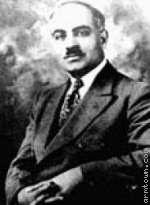
Turkish writer Orhan Pamuk has won the 2006 Nobel Prize in Literature.
Pamuk, 54, has gained a reputation for tackling controversial issues through his novels and has faced legal action in his homeland.
Awarded by the Swedish Academy, the Literature Prize comes with a cheque for 10m kronor (£740,000).
The Academy said: "In the quest for the melancholic soul of his native city, (Pamuk) has discovered new symbols for the clash and interlacing of cultures."
It added: "Pamuk has said that growing up, he experienced a shift from a traditional Ottoman family environment to a more Western-oriented lifestyle.
"He wrote about this in his first published novel, a family chronicle... which in the spirit of Thomas Mann follows the development of a family over three generations."
He has published six books in English, the first of these being The White Castle, primarily a historical novel set in 17th-century Istanbul, but also about how stories and fictions build self-perception.
He has faced prosecution for talking about the murder of hundreds of thousands of Armenians in Turkey during World War I and thousands of Kurds in subsequent years.
Under a 2005 law it is illegal for anyone to insult Turks, the republic or Turkish Grand National Assembly.
The charges have since been dropped.
Last year's winner was British playwright Harold Pinter, a vociferous critic of US foreign policy. That award triggered accusations that the Swedish Academy was anti-American, left-leaning and politically motivated.
The prize is awarded to "the person who shall have produced in the field of literature the most outstanding work of an idealistic tendency".
It is given to recognise a body of work, rather than an individual book.
http://news.bbc.co.uk/2/hi/entertainment/6044192.stm
Monday, May 12, 2008

Bulgaria's Dobrich Recognizes Armenian Genocide
29 April 2008, Tuesday
The Municipal Council of the northeast Bulgarian city of Dobrich adopted Tuesday a declaration recognizing the genocide over the Armenian people in the Ottoman Empire in 1915-1922.
Twenty-five of the total of 32 municipal counselors voted in favor of the declaration, one voted against, and five abstained, the Bulgarian private Darik Radio.
Before the voting, the regional leader of the ethnic Turkish Movement for Rights and Freedoms Denis Noman suggested that the issue be removed from the agenda because it was a matter of interstate relations, not of local government.
The motion of the Municipal Council was approved by Armenian community in Dobrich whose representatives were present during the voting.
They did not fail to point out that Bulgaria was the first country to offer asylum to the Armenian families, who were chased away by the Ottoman authorities.
Over 40 000 presently live in Bulgaria but only about 200 live in the city of Dobrich.
With Tuesday's declaration Dobrich becomes the tenth Bulgarian municipality, which has recognized the Armenian genocide, including the cities of Burgas, Ruse, and Silistra.
On April 24, the international Armenian Genocide Remembrance Day, the Sofia City Council honored the memory of the genocide victims. A similar declaration was read there but the Council failed to vote on it as it was taken off the agenda with the motive that the issue was not within its competence.
http://www.novinite.com/view_news.php?id=92690
The Municipal Council of the northeast Bulgarian city of Dobrich adopted Tuesday a declaration recognizing the genocide over the Armenian people in the Ottoman Empire in 1915-1922.
Twenty-five of the total of 32 municipal counselors voted in favor of the declaration, one voted against, and five abstained, the Bulgarian private Darik Radio.
Before the voting, the regional leader of the ethnic Turkish Movement for Rights and Freedoms Denis Noman suggested that the issue be removed from the agenda because it was a matter of interstate relations, not of local government.
The motion of the Municipal Council was approved by Armenian community in Dobrich whose representatives were present during the voting.
They did not fail to point out that Bulgaria was the first country to offer asylum to the Armenian families, who were chased away by the Ottoman authorities.
Over 40 000 presently live in Bulgaria but only about 200 live in the city of Dobrich.
With Tuesday's declaration Dobrich becomes the tenth Bulgarian municipality, which has recognized the Armenian genocide, including the cities of Burgas, Ruse, and Silistra.
On April 24, the international Armenian Genocide Remembrance Day, the Sofia City Council honored the memory of the genocide victims. A similar declaration was read there but the Council failed to vote on it as it was taken off the agenda with the motive that the issue was not within its competence.
http://www.novinite.com/view_news.php?id=92690
Thursday, May 8, 2008
"That is all right, but who killed hundred of thousands Armenians?"
Hasan Amca: "That is all right, but who killed hundred of thousands Armenians?"
This article was published in Turkish “Alemdar” daily in 1919 by Hasan Amca – Turkish politician and eyewitness of the Armenian Genocide. The rhetoric and analysis of the text seems actually for our days and that is why it also could be regarded as an address to the current Turkish leadership. Hasan Amca wrote also memories on the Armenian deportations, which unfortunately is lost. After the end of the First World War Hasan Amca authored series of media publications in Turkish media on condemnation of perpetrators and denialists of the Armenian genocide during the court cases against the main organizers of the Armenian Genocide.
"Let Your Excellency not allow using “extermination” and “deportation” whether or not they are two synonymous words. You may use as you like; the expression will not lose its practical meaning. It has only well-known tragic meaning of what happened.
Be sure, I have once more read your article and I still do not want to believe that it belongs to your pen. How can one write such things even under national inspiration, religious annoyance or personal persuasion? Is it possible to reject blood of hundred of thousands innocent people and believe in some Suleiman Nazif Bey, supporter of murderers?
Live away the words “extermination” and “deportation”. Proclaim that it is decision to “annihilation of the Armenian nation” and let there remain no place for dispute. That decision was made by the gang of robbers of Ittihat ve Terrakki. It made high ranked officials carry out those special measures. You deny it, is there any necessity to insist on it? I do not know.
I must leave this problem and proofs to future to clarify your article.
You state, “Country, because of war stipulation, had a necessity to deport a part of population from war regions and had to pass a law connected to it”.
That is all right. Do you find it lawful and justified advising to use the fact of deportation unequal to extermination. According to what right the government usurps house, family property and money of its own citizen?
What kind of war necessity made them deport the women to the unknown Der-Zor desert with suckling baby, taking by the arm of a three years old child, they grabbed money in the first station, which will be enough only to buy bread for a day.
Ponder a little before saying “leaving from war regions”, necessity to comprise war regions and also deportation of the Armenians from those regions expanded from Edirne to Basra.
All right, but don’t you understand that you close the danger by deporting Armenians from Kaisery to Der-Zor, which is the back of the 6th army, and approaching them to the back of the 4th army of Hauran.
Whole area of the country became stage of general war. The “necessity” arisen by the war was to move the Armenian nation from that region. It would be more logical if you supported it in following way, “there was left no place on the earth, the country became topsy-turvy, and thus we decided deporting and driving places”.
And also the law... Not only my, but in the name of the whole nation, please do not repeat that bloody and terrible word like Ittihat ve Terakki.
Do not repeat that wild word to relax the conscience of nation, because of which hundred of thousands sons of the country were hanged, hundred of thousands were shot, hundreds of thousands innocent children and women were smashed to pieces with ax, thousands widows and orphans were starved to death. Protests addressed to “our statesmen supplying all the good” heard from the bravest mouths had only instant life and under the reign of those cruel people who perpetrated all these crimes, the population of the empire was drunk with that wild word giving them pompous.
I am sure that only few citizens can give the brightest and clearest explanation of the law except you. The law that makes you express called deportation by you must be carried out first of all for your family.At that time to realize the meaning of applying a law you will have strength to ponder on deep philosophy, to correspond the law to the God’s law, conscience and logic. You will be able to conclude that there exist several hundreds of ayats in the holy book and constitutional articles to reject and curse this crime.
And you consider it as a law adopted by four bloody and foolish people? As if that word has power to transform all those crimes into humanness and you think the statesman deserves to amnesty following that example. How should it be?
The man mentioned by you who carried out the order by Talaat first of all is a human being and then a Muslim. There exists constitution for being a human being and being a citizen of the Ottoman Empire, there are given hundreds of promises to be faithful to its points and there exists a holy book, which contains Godly principles and demands that a human being with its behavior preserves those principles.
This is the essence of the order, law if it corresponds to those principles the Muslim official tries to carry them out. I think you disregard necessary respect of the Holy book in the result of your efforts to support five-six foolish murderers of the Ittihat ve Terakki.
You are the one to tell, “Our government is not responsible for a special committee, participation and crimes of others”. I beg to Your Excellency to explain once more the point.
I hear from you that the government consists of positive, that is people obeying laws and not positive /opposing laws/. What is that government called?
When you say there were officials in the deportation regions who carried out demand of the law reasonably and even “defended and were kind-hearted”, I do not know what you mean by saying the expression “defended and kind-hearted”.
Do you think that “defended and kind-hearted” man may take a woman with three-four children out of the house with “mealy-mouthed” and send them to the mountains, uninhabited deserts where even grass is not found or a place to meet death? Is that all?
That was “defended and kind-hearted” deportation that I saw. You say who passed “border of duty”, were dismissed by Talaat pasha in spite of his wish who is the most influential person in the government. I should ask the following questions with your allowance that Talaat pasha was a legal or an illegal person or was he a bastard?
There is another “border of duty” in this problem. I leave it for you to clarify.
In all cases defense and kind-heartedness were within border of duty of deportation. I recognize many people who rose with the ladder of service after having passed the normal border and being whipped. May Your Excellency point a punished person by that “positive” government? You accept not to show that “negative” persons were a progress in the war field for realizing the deportation.
Reshid vali, who left for Diarbekir with two suitcases after organizing a slaughter returned with wagons. Then he was appointed vali in Ankara as I think for punishment.
Believe me; the latter got the most severe punishment compared with others.
“Even if there is no official order for extermination and plunder, there will always be resigned and dismissed officials who will not keep silent”, are you speaking seriously?
If we keep silent, it is only to inspire crimes of several people. It is to honor wounded and bloody hearts for not piercing and breaking them once again. But if we speak on them, that will mean to sound something well-known to everybody.
If there are people who defended Armenians from extermination and massacre, their activity came from courage, humanness and conscience typical to them. Activities of such individuals as Bekir Sami, Hyusein Kyazim and Dr. Arif, personalities who deserve to be recorded in accounts of the government Ittihat ve Terakki, yesterday they were considered to be persons of high-treason, feeble, coward and mean.
They achieved that honorary goal acting opposite to the official orders of the government. Not the government gave legal orders and the honorary officials carried it out well. Your Excellency knows it very well.
But how can one not get surprised by wrong viewpoints and conscious instigating wrong defense?
The murderer Kemal from Yozghat says,
-The government has not carried it out.
An improvident member of Ittihat ve Terakki says,
-Ittihat ve Terakki has not made such decision; it even punished several people for abuses, - he is not ashamed of saying it, he does not avoid of it.
If we ask a poor Turk, he would answer,
- I came back from war. My neighbor Avetis agha, a smith, Nikoghos Chorbadjin, I do not know many of my neighbors have been robbed; they have been drawn to Arabistan or elsewhere.
All right, we will not speak unless anybody asks. However, the God who is one for a Christian, Turk, and Armenian will ask with loud and ruthless voice.
That is all right, but who killed hundred of thousands Armenians?"
“Alemdar”, April 5, 1919, Constantinople
Turkey's hidden Armenians
After the genocide of the early 20th century, Armenian identity in Turkey has been hidden or even pushed away for fear of discrimination.
See the special report.
http://www.france24.com/france24Public/en/special-reports/FRANCE-24-Reports/20070504-Reporters-hidden-Armenians.php
See the special report.
http://www.france24.com/france24Public/en/special-reports/FRANCE-24-Reports/20070504-Reporters-hidden-Armenians.php
Wednesday, May 7, 2008
Armenian Genocide Documentary
The Betrayed:(Armenian Genocide Documentary)
http://video.google.com/videoplay?docid=-7833166317264817428
http://video.google.com/videoplay?docid=-7833166317264817428
Monday, May 5, 2008
The Armenian Genocide: Prof Vahakn Dadrian's Lecture at Harvard
Vahakn Dadrian, Ph.D.
Harvard University
April 24, 2001
I would like to discuss the significance of the Armenian Genocide in the light of Turkish denials. The Armenian Genocide has many significant characteristics, such as, that they were victimized in their own ancestral territories, that religion was a powerful instrument in inciting the masses, even though the perpetrators, the arch perpetrators, were themselves mostly either atheistic or agnostic.
The Armenian Genocide is also significant by the fact that there was massive, popular participation in the atrocities. It was also significant by the fact that, to quote Ambassador Morganthau, "to save shell and powder," the perpetrators deliberately used blunt instruments, thereby protracting the agony of dying of the victims. This should never be lost of sight, in terms of the very significant nature of the Armenian Genocide: protracted agonies in dying, because of the decision of the perpetrators to avoid bullets and use instead blunt instruments.
And then, of course, the major feature of the Armenian Genocide, which deserves focal attention: the persistent denial of what Toynbee called "this gigantic crime that devastated the Near East in 1915." This denial imparts to the Armenian Genocide extraordinary significance, not only for the Armenians themselves but also in terms of subsequent perpetrators that appeared on the horizon since World War I.
Because the denial is a function of impunity, people who escape punishment become defiant, become very bold in terms of rationalizing the crime, and most importantly, they embolden, by way of political contagion, other potential perpetrators. Therefore, the denial of the Armenian Genocide requires special attention as it terribly encumbers the problem of documentation. Deniers are wont to withhold evidence; deniers are wont to destroy evidence. Therefore, a scholar of the Armenian Genocide has to be by necessity not only a scholar but also a detective.
Holocaust scholars are besieged - saturated - with overwhelming evidence because of the German, Teutonic passion for recordkeeping. That condition is totally absent in the case of the Armenian Genocide. Specifically, the denial syndrome has three major elements: the denial of the crime, the denial of the victim, and even the denial of third parties to pass or to render a judgment on it.
Therefore, let me briefly outline the specific elements of denial, because, before a crime of such magnitude as the Armenian Genocide can be documented, you have to confront and overcome the specific elements of the denial. The Turks - past and present - deny that the Armenians were subjected to massacres, but rather they were subjected to deportation. Number two, the point is made that not all Armenians of the Ottoman Empire but only a segment of the Armenian population, specifically in the war zones in the eastern provinces, were subjected to deportation. Number three, the Armenians provoked the authorities to take drastic, draconian measures that ended in tragedy, but that the provocation came from the Armenian side.
Then there is the argument that if atrocities took place, they were reciprocal. Armenians killed Turks; Turks killed Armenians. And finally, I think the most overwhelming aspect of Turkish denial that deserves specifically confrontation and debunking is the argument of "civil war." Because of brevity of time, I cannot deal with all the specifics of this denial. But I will focus very briefly on the argument of "civil war," because it is persistent and paramount. Even today, during dinner, one of the Armenian students in the business school at Harvard was telling me that a Turkish student, as fresh as recently, told her that the Armenian Genocide is not reality because what happened was simply a "civil war."
So this argument is being broadcast throughout the world by Turkish agents, by the Turkish ambassadors, by the Turkish consuls, and some very gullible third parties that are not informed about the case have absorbed this argument of "civil war."
By any definition, "civil war" means the collapse of central authority, and the subsequent onset of a vacuum. As a result, factions begin to fight one another in the absence of central authority. Let's examine whether this was the case in World War I affecting the Ottoman Empire. Let me briefly describe what the authorities did before the Genocide was enacted. First and foremost, this is one of the basic conditions of the Armenian Genocide: Several months before embarking upon the Armenian Genocide, the Young Turk Ottoman authorities dissolved the Ottoman parliament. Talaat Pasha in his subsequent post-war memoirs indicates that he didn't want any argumentation or discussion in his own parliament as some humanitarian Turks might have objected; he wanted total freedom and control. And this is an exact replica of what happened to the Jews during the Holocaust. Before the Holocaust was initiated, the Reichstag was destroyed and the entire authority was transferred to the executive branch of the government.
Secondly, the Turks declared martial law. You know what martial law is: total control of movement, censorship, isolating provinces from one another, total control of communication, and the threat of swift and severe military punishment. And then, of course, the secret service was mobilized.
In other words, the Ottoman authorities not only were in full control, but they also had concentrated power in their hands to run the affairs of the Ottoman Empire. But I think that the most significant feature of the futility of the argument of "civil war" is this fact: On August 2, 1914, three days before World War I broke out, the Ottoman authorities declared general mobilization, as a result of which all Armenians, citizens of Turkey, in the age category of 20 to 45, were conscripted into the Ottoman army.
You can imagine the agony, the petrified feelings of the remaining Armenian population, which consisted of old men, children, and women - very much aware of the fresh massacres of 1909 in Adana and still remembering the harrowing massacres of 1894-96. There was terror in the population, and to think that this collection of old men, women, and children would even dare to think to confront the Ottoman army, to confront fully armed Muslims throughout the empire. Where is going to come the logistics? Where is going to come the weaponry? Where is going to come the command and control system of this terror-stricken population whose main concern was how to survive the war?
The frivolity of the argument of "civil war" is exceeded only by its absurdity. And even today, some enlightened Turkish historians are advising their colleagues not to use this argument, because not only is it absurd, it undermines the Turkish position. Any application of simple logic will demolish this argument.
Let me now point out that, if denial is persistent, if denial is truculent, what is to be done to overcome the problem in terms of documentation. Any documentation has to be adjusted to the specifics of the problem at hand. I submit to you that the documentation of the Armenian Genocide in the light of this persistent denial requires specific methodology. It cannot be simple documentation. It has to be documentation of a special kind that overwhelms the deniers.
And I call this, in my definition, "compelling evidence." Not simple evidence but compelling evidence is needed.
What are the specific elements of compelling evidence? There are four of them. Number one: The evidence has to be reliable. By this I mean that the source has to be more or less unimpeachable. For instance, to illustrate the point: American Consul Leslie Davis from Kharpert is graphically describing the atrocities in Kharpert province; he had taken a Turk to be a guide to him, and it was this Moslem Turk who showed all the spots, all the sites of atrocities while providing graphic details. To me, this is reliable. I would be skeptical if his guide and informant were an Armenian. But here is authentic Turkish evidence supplied to an American consul. That I consider adequately reliable.
The second element in my definition of compelling evidence is what I call "explicitness." Was it deportation? Or was it the destruction of the deportee population? My research suggests categorically that the deportation was a cover to enact the intended goal of deportation, which was the destruction of the deportee population.
The third element in my definition of compelling evidence is "incontestability." I think incontestability applies largely to official documents, and I will briefly explain to you German, Austrian, official Turkish documents which attach extraordinary significance to the evidence in terms of incontestability.
And finally, in my definition of compelling evidence, the fourth element is "verifiability." If I make a point and suggest a reference, a document, anybody should be able to go to the source of that document, verify its existence and its content. That is called verifiability. Therefore, the overcoming of the Turkish denial requires compelling evidence in terms of these four elements I just described.
So the question arises, given the present conditions, what are the avenues by which compelling evidence can be located, secured, and obtained? I use a methodology for this purpose, which I call the "exclusion/inclusion polarity."
In other words, I exclude from my research all evidence, all data that may be one way or another associated with the enemies of the Ottoman Empire during World War I. By this definition, I avoid if I can, documents emanating from British archives, from French archives, and from Russian archives. All these three countries were enemies of the Ottoman Empire. Not that they are devoid of any value. On the contrary - specifically British archives - are full of authentic documentation, but because they are emanating from the enemies of the Ottoman Empire, they invite doubt and they entitle the Turks to inject an element of doubt, saying that this can be enemy propaganda.
The same applies, to some extent, to what I call "Armenian survivor accounts." Here again, some Armenian survivor accounts, specifically in the period of 1920s, 30s, and 40s have powerful material of documentation that is firsthand, fresh in the aftermath of the Genocide. Not these recent surveys of 80-, 90-year-old Armenians, whose memories are dim, who tend to mix reality with fantasy, embellish, become hostage to selective memory, et cetera.
None of these conditions are present in this massive volume of Armenian survivor accounts that is still awaiting exploration by way of translation and analysis. Some day, when there is a vibrant and viable Armenian republic with a resource-rich academy, young Armenian scholars will focus more on this data and less on the survivor accounts of the last two decades. So, I exclude from my research Armenian survivor accounts as well - again, not that I am intent on diminishing their value, but to deny the deniers the argument that this is "victim bias." It is true, more often than not, victims are prone to bias. This is a universal condition.
So what is left after this exclusionary procedure; What can I include, to produce compelling evidence? I have two classes of documentation which, I believe, meet this condition. One of them is the archives of the allies of Ottoman Empire during World War I: Imperial Germany and Imperial Austria-Hungary. I have been to the German archives in Bonn 18 times in the last 20 years, and I have hundreds and hundreds of German documents, detailing graphically, day in and day out, the atrocities taking place in the interior of Turkey during World War I, produced by German officials: consuls, vice consuls, military officers, et cetera. And the same with Austria-Hungary.
It is inconceivable that a military and political ally, during the war, would try, would venture to discredit another ally. It is inconceivable. On the contrary, German and Austrian officials went out of their way - for a long time after the Genocide was initiated - to protect the reputation of Turkey. They expressed doubts concerning the truth about massacres, until it dawned on them by massive evidence, beginning in June and July, that this was not an ordinary initiative of massive deportation.
And when you read the German documents again and again, the single word used by ambassador after ambassador is the German word Ausrottung, which means purely and plainly "extermination."
But most importantly, why I think that German and Austrian documents are more than compelling evidence is this fact: They were not intended for public consumption. They were wartime reports meant to be used by the superiors of these officers for what is called "in-house use," internal use.
This fact immensely amplifies the significance of the authenticity of these documents, which were not meant for public consumption: Subordinate officers informing their superiors about the facts, which was their assigned duty to do, namely, to report as to what is transpiring in their districts.
The second class of categories I use are authentic Turkish documents. Here is a paradox: On the one hand I am saying that Turks are denying that they are withholding documents, they have destroyed documents, which are true. How can you then explain the existence of valid Turkish-Ottoman documents? Well, the fact is that no matter how meticulous you are, no matter how careful you are, for a crime of such gigantic dimensions as the Armenian Genocide was, it is practically impossible to destroy every bit of evidence. Almost invariably, some documents survive. And these are the documents I propose and I do use in my research.
What kind of documents are they? There are three such sub-classes of surviving Ottoman documents. Number one, that has been discussed briefly previously by Professor Bardakjian, the documents of the Turkish military tribunal. When Turkey at the end of October 1918 laid prostrate and asked for a suspension of hostilities, the victorious allies - France, Britain, and Italy - stipulated, among others, a condition to postwar Turkish authorities.
They said, "Unless you prosecute and punish the authors of Armenian deportations and massacres, the conditions of the impending peace will be very severe and harsh." In part, to accommodate the victorious allies, successive postwar Turkish governments established court martials in Istanbul, Turkey.
Attached to these court martials was an inquiry commission, which was invested with extraordinary powers of subpoena, arrest, et cetera. So this was called the Mazhar Inquiry Commission. For about seven weeks, Mazhar Inquiry Commission secured from many provinces of Ottoman Turkey authentic, official Ottoman documents.
From Ankara province alone, they acquired 42 documents, which mainly involved correspondence between two military commanders. One of them, Colonel Recayi, was the acting commander of the Fifth Army Corps stationed in Ankara, and the other, Colonel Sahabeddin, the acting commander of the 15th division in Kayseri. The correspondence mainly involved regular accounts of the process of liquidation of the province's Armenians.
I give you an example: The military commander of Bogazliyan, a district in Ankara province, sends a cipher telegram to his superior in Ankara, Colonel Recayi. He says, "Today we dispatched so many Armenians to their destination." In Turkish, Müretteblerine Sevk. Colonel Recayi, pretending not to understand, wires back saying, "What do you mean, 'dispatched to their destination?'" The answer comes within an hour: "They were killed off" (Katledildiler).
And so, the court martial secured dozens of such documents from Ankara province alone, and they were introduced in the court-martial proceedings.
Now, people like Justin McCarthy and some other people are trying to diminish and disparage the court-martials, calling them "kangaroo courts." Why are they not kangaroo courts? For the simple reason, mainly, that the Ottoman prosecutors went out of their way to disregard Armenian survivor testimony so as to render their verdicts as solid as possible.
The bulk of oral testimonies was discounted for this reason. That is what happened in Nuremberg as well. As in Nuremberg, so in Istanbul, not all but most verdicts were predicated not upon witness testimony but upon official and authenticated documents of wartime provenance.
Why are they, and how are they, authenticated? By a stipulation of the court martial, before a document was introduced in the court martial as an exhibit, Ottoman Interior Ministry officials were asked to authenticate them. And after doing so, on top of the documents it was stamped, "It conforms to the original" (Aslina Muafikdir).
So, here is your court martial. All wartime documents that have nothing to do with postwar politics, as implied by people like Justin McCarthy. This is then the military tribunal's evidence.
The second category of Turkish official documents involves parliamentary debates. For about seven weeks - October, November, December 1918 - in both chambers of the Ottoman parliament - the senate and the lower house - debates took place about Armenian deportation and massacres. Several deputies came to confess, to confess the crime of massacres against the Armenians.
And I give you three examples of how shattering they are, in the face of all those who still persist in denying the Armenian Genocide. These are official declarations in the postwar Ottoman parliament by Ottoman deputies and Ottoman senators. On October 19, 1918, on the first day of the opening of the Ottoman senate, the president of the Ottoman senate, Ahmed Riza, a former Young Turk leader himself, made this declaration. He said, "We Turks savagely killed off the Armenians." He used the Turkish word vahsiyane. This is the president of the Ottoman senate, not only admitting the killing of the Armenians, but using the adjective "fiendish, savage."
Two days later, a veteran and retired general of the Ottoman army, challenged him, saying "How do you dare to mention only the Turkish atrocities but ignoring Armenian atrocities against the Turks?"
Ahmed Riza gave an answer, which is a clue to the character of the Armenian Genocide as a historical fact. He said, "Yes, we knew the Armenians out of vendetta killed some Turks. They were people who noticed their parents had vanished and they were vindictive and they killed. But the Armenians were not killed en masse by individual Turks; they were killed wholesale by the official policy of the central government of the Ottoman empire."
He used the Turkish word resmi, which means "official." In other words, the Armenians were obliterated by the decision of central authorities. This is a very significant fact. On November 21, 1918, in the same senate, the most remarkable revelation was made by another senator, Resid Akif. This man was an Ottoman statesman, and on that day he made this declaration. He said, "I was a member of the first postwar Ottoman government, and one day in my office, I came across two types of documents. One was the official order of the interior ministry, Talaat, ordering the deportation of the Armenians, in which - and the Turks are using these secret telegrams now - in which Talaat is telling his subordinates, "Protect the Armenian deportee convoys. Give them olives and bread." Et cetera, et cetera.
But parallel to this, an informal order goes out from Constantinople, issued not by any government agency but what sociologists call "informal authority," namely the Central Committee of the Ittihad party, i.e. CUP. He says "The order was simple. As soon as the Armenian convoys leave their villages and towns and cities, proceed with the execution of the mission," and Akif Pasha says the mission was for these criminals to attack the convoys and massacre the population. This is the testimony of Akif Pasha, a high-ranking and distinguished Ottoman statesman.
And finally, let me give you one more example of official Turkish testimony in the parliament. On December 11, 1918, the deputy of the province of Trabzon, Hafiz Mehmed, a lawyer by profession, made this declaration. He said, "I, Hafiz Mehmed, I personally saw with my own eyes in the port city of Ordu on the Black Sea, how one night Armenian women and children were being brought and loaded into barges, taken off to the high seas, drowned there at night, and then the barges would come back empty."
Massive drowning operations took place in the various port cities of that Black Sea littoral, and here is a Turkish deputy admitting it in the Ottoman parliament. These are the parliamentary debates. Then of course comes the Fifth Inquiry Commission, Besinci Sube Tahkikat Komisyonu, which is very significant because the parliament wanted a legislative investigation, independent from the judiciary, whose venue was the Turkish court martial. So they created their own inquiry commission, as a result of which all members of the two wartime cabinets were brought in and investigated through official hearings.
During these hearings, remarkable admissions were made. One of them belonged to Said Halim Pasha, the wartime grand vizier, which corresponds to the position of prime minister. He said, "The Turkish government, my cabinet, we gave orders for deportation only, but the order for deportation was transformed into operations of killing which we never agreed upon."
Said Halim Pasha, the prime minister of Turkey, declaring that the order of deportation was transformed into an order of killing by dubious organizations, and he mentioned the Special Organization, Teskilati Mahsusa. And then the wartime minister of justice, Ibrahim, made an equally remarkable revelation. He said, "I was pressured by war minister Enver to release from the prisons of the Ottoman Empire criminals for patriotic duty."
He said, "I advised him that Ottoman constitution, Ottoman law, prohibits convicts from being employed as soldiers. I was pressured, and a substantial number of them were released" (mühim bin yeküna balig). They were used for massacre duty against the Armenians. All these are but samples of the litany of other confessions made during these hearings. So there it is, a corpus of documentary evidence culled from the transcripts of court martials, parliamentary debates, inquiry commission; and above all, authenticated Turkish documents.
Briefly, about the German documents, every German ambassador - there were four of them: Wangenheim, Hohenlohe, Metternich, and Bernstorff - all of them regularly informed Berlin that the Christian minority in Ottoman empire, under the guise of deportation, is being exterminated under the most fiendish conditions.
Dozens and dozens of such documents emanating from German ambassadors are now deposited in the German archives. And the same with Austrian archives. Now, having these two classes of documents - German and Austrian on the one hand, Turkish on the other hand - this ensemble I consider eminently qualifying for my criterion of compelling evidence. On the basis of this, I would like to reconstruct very briefly the Armenian Genocide, because, as a rule, perpetrators will not volunteer to provide blueprints as to how they proceeded. We have to reconstruct on the basis of acquired evidence that is, as I said, compelling.
On the basis of that, there are four determinants of the Armenian Genocide requiring special attention for research and study. Number one: Premeditation. Number two: Genocidal intent. Number three: Organization of the genocide. Number four: Execution of the genocide.
Let me briefly describe this. Premeditation. In all systems of criminal justice, the most severe penalties are reserved for premeditated crimes. Because there is prior deliberation, therefore the person should be aware of the consequences. There is significant evidence that the Armenian Genocide was NOT - and I emphasize the word - an aberration of World War I.
Even Benjamin Whitaker, the British member of the United Nations Subcommission on Human Rights, in acknowledging the Armenian Genocide on behalf of that subcommission, in order to placate the Turks, to assuage Turkish pride, said, "Oh, the Turks lost their control, it was wartime condition." In other words, the Genocide was a crime of passion. I am afraid Benjamin Whitaker is quite wrong. There is ample evidence that the Armenian Genocide was a premeditated crime, and I would like to adduce here, very briefly, some documentary evidence.
Vice marshal Pomiankowski, the Austrian military attaché attached to the Ottoman headquarters throughout World War I - and he was on duty in Turkey for ten years, i.e., from 1908 to 1918 - says that during his duty in the Ottoman headquarters, he was told several times by Turkish officers and intellectuals that many of these very same people considered previous sultans being very deficient in their treatment of the Christian and nonMuslim minorities, telling him that these sultans should have forced these nonMuslim entities to embrace Islam, and failing to do so, they should have exterminated them.
They told him, there is now a precious opportunity to rectify the mistakes of past sultans and therefore, Pomiankowski concluded: The annihilative treatment of the Armenians during the war was in fact a function of this recognition of the mistakes of past sultans, and that the Armenians and Greeks either should be forced to embrace Islam or be destroyed.
I think the most devastating document about premeditation comes from the German colonel Stange. He was the only high-ranking German officer who was in charge of a special organization detachment. Most of his charges were convicts released from the prisons. On August 23, 1915, Colonel Stange prepared a lengthy report: 16 legal-sized pages of which I have a total copy, in original German.
He says that he regrets to inform him - he is referring to Marshal Liman von Sanders, the head of the German Military Mission to Turkey - that "the Turkish government is misleading our government in Berlin in terms of the case of the Armenians." And in that lengthy document, Stange explicitly declares that the decision to eradicate the Armenians during the war was made a long time before the outbreak of the war. In his original German language. "Einen lang gehegten Plan": This is exactly what he says in German.
Then of course, the most devastating evidence of premeditation comes from Turkish court martial proceedings. In the key indictment of the Turkish military tribunal, which is produced in the legal journal of the Ottoman parliament, Takvim-i Vekyi, number 3540, page 8, this is what is said in the key indictment: "There is evidence that one of the architects of the Armenian Genocide, Doctor Nazim, had warned the governor of Aleppo, Jelal, to the effect that the anti-Armenian measures were not the result of impulsive decision-making but the product of "profound and long deliberations" (ariz ve amik düsünülerek). In response, Governor Jelal told the Ottoman authorities, "I can deport the Armenians but I cannot have them massacred! I cannot soil my hands in the blood of innocent people." He was relieved of his post and assigned to Konya province, where, as he continued to protect the Armenians, he lasted but a few months. And finally, in the several verdicts of the Turkish Military Tribunal - namely Yozgad, Trabzon, Erzincan - the Arabic word of premeditation is expressly used, i.e., ta'ammüden. In the Bayburt verdict, the court again declared that the destruction of the Armenians was the result of a prior deliberation.
When we come to Austrian documents, German documents, you see again and again that they say that the treatment of the Armenians during the war was meant to be the "final solution of the Armenian question." In about eight months, the most prominent academic journal in the world, which is the journal for Turkologists, Ottomanists, and other specialists of the Middle East, International Journal of Middle East Studies, will publish a major article of mine in which I will document and explain all these matters. Indeed, German and Austrian documents again and again say that the destruction of Armenians had very little to do with the behavior of Armenians during the war, that it was intended to finally solve once and for all the lingering and for the Turks troublesome Armenian question by in fact liquidating the Armenians.
Now, regarding genocidal intent. In the definition of the United Nations, in order for mass murder to qualify for a genocide, there has to be an intent to destroy in part or in whole the victim population. Genocidal intent is explained again and again by practically all the verdicts of the Ottoman military courts. Especially the Yozgad verdict declared that the deportation was a guise to destroy the deportee population, adding that "there can be no doubt and hesitation about this" (Süphe ve tereddüt birakmadigindan). In brief, genocidal intent is explicit in Turkish, German, Austrian-Hungarian documents.
Organization of the genocide, the third element. Here again, the Ottoman court martial had a specific class of trial series reserved not for government officials but functionaries of the Young Turk Ittihad party. This in a sense is unprecedented in the annals of legal justice, that no governmental officials but people with what sociologists call informal authority, namely party functionaries, are being tried in terms of unofficial adjuncts to the government, dominating that government. This problem of informal authority in genocide is the least appreciated and hence the most neglected aspect of it.
And then finally, the execution of the Armenian Genocide. I think here you see an event which is unparalleled in the annals of human history. The two major perpetrators - the architects of the Armenian Genocide, Doctor Nazim and Doctor Sakir - in their consultations with their colleagues in the Central Committee, repeatedly declared in so many words that "Sultan Abdul Hamid did an unfinished job; we cannot be satisfied with partial results, therefore in order to be complete, drastic, and definitive about the destruction of the Armenians, we need criminals. We have to be merciless with women and children."
And therefore they persuaded their colleagues to release from the prisons of the Ottoman empire the most bloodthirsty criminals. For this class of criminals some authors used the word kanli katil. What did they do? They sent to every prison teams consisting of three members: a member of the department of war, a member of the interior department, and, most significant, the third member was a physician, whose job it was to select the most savage-looking criminals for merciless behavior in massacre. So they went from prison to prison, these teams, and selected convicts from the various prisons of the Ottoman Empire.
And in this respect, I like to make a reference to a very powerful court martial document that was mentioned before, and this is the written testimony of Ottoman Third Army Commander-in-Chief Vehib Pasha. When the Genocide was all but finished in the eastern provinces at the end of 1915, the Turkish High Command appointed General Vehib commander of the Third Army. His predecessor, General Mahmud Kamil, was installed there by the pressure of the three architects of the Genocide: Doctors Nazim, Sakir, and CUP's high priest, Ziya Gökalp. War Minister Enver, in February 1915, had originally appointed General Vehib to the Third Army who thus became supplanted.
Why is the Third Army so important? Because the jurisdiction of the Third Army embraced the six major "Armenian provinces:" Van, Bitlis, Erzurum, Diyarbekir, Sivas, and Kharpert. And Trabzon was attached to that army jurisdiction.
General Mahmud Kamil, who completely shared the ideology of these three men, did a thorough job. Totally identified with these three men, he supervised the destruction of all the Armenian male population and the subsequent deportation of the remaining Armenians in the six provinces. He then retired and as Undersecretary in the war ministry came to Istanbul in February 1916. And the court martial asked Vehib to prepare an affidavit as to what he saw as commander of the Third Army. On December 5, 1918, Vehib prepared a 12-page affidavit, a copy of which I have. In that affidavit, he says that "When I came to my post in Erzincan, I saw that the Armenian population had vanished, no trace of the Armenians in the entire region. I immediately suspected that a major crime had been committed, but being a military officer I could not investigate out of curiosity. I was waiting for an opportunity, and that opportunity came." What happened in 1916 was this. The Baghdad Railway construction managers needed additional workers. They asked Vehib to transfer from Sivas to Adana 2,500 Armenian labor battalion soldiers who were still alive. So he issued an order for their transfer, and within 48 hours these 2,500 Armenian soldiers vanished. There were inquiries, and Vehib said "I sent them," so he made an investigation and he established that the governor of Sivas, Muammer, had given oral orders to the gendarmerie commander in charge of these 2,500 Armenians to liquidate them. It developed that under the most fiendish ways, these 2,500 disarmed labor battalion Armenian soldiers had their hands tied with axes, swords, et cetera, brutally massacred, and some of them thrown off the rocks into abysses had just disappeared.
So Vehib said that here was an opportunity to investigate. He established a court martial and hanged the two major perpetrators of the massacre of these 2,500 Armenians. In his affidavit, General Vehib gives detailed description of how the Armenian Genocide took place. He says that Dr. Sakir, one of the main architects of the Armenian Genocide, went from province to province with a private automobile and gave verbal orders to people. Vehib then describes the release from the prisons of the most brutal, fiendish criminals. (Ipten ve kazikdan kurtulmus yaranini.) That's the original language he uses. And then, he describes a scene of atrocity that epitomizes the quintessence of the Armenian Genocide.
He said that he went to Mus in Bitlis province, and he went to Tchurig, a small Armenian village five kilometers north of Mus. And here he describes what he saw: "In all the wooden houses of that village, Armenian women and children were crowded and burned alive." And he says, "I saw their charred remains." And then he uses this language at the end of his affidavit. He said, "In the history of Islam, you cannot find any parallel to such fiendishness and savagery." This is a Turkish army commander, an Ittihadist himself, who is speaking up. And then he finishes his affidavit, saying, "Divine justice may be be delayed, but it cannot be forfeited." (Adaleti Allahiyede imhal var ihmal yoktur.) To conclude, what do we learn from all this? I think the single most characteristic of the Armenian Genocide, especially in comparison with the Holocaust - and I think here you see a conspicuous striking parallel, a convergence - is this: Not the regular organs of the Ottoman state, but the secret party organization of the Young Turk Ittihadist Party was in charge of the Armenian Genocide, from beginning to the end: Conception, premeditation, decision, organization, implementation - they are all done primarily, if not exclusively, by the trusted officials of the Young Turk Ittihad Party, just like the Nazis in Germany, in World War II.
You know, the Third Reich was divided into Gaus, provinces, and high-ranking party representatives, the so-called Gauleiters were in charge. Likewise, the top Nazi National Security Agency, the Reich's Sichereitshauptamt - RSHA in brief - was the main instrument of the Holocaust, together with the SS and the Gestapo. All of these outfits were run by party fanatics. A similar set-up functioned in the organization of the Armenian Genocide. Here we see the functionaries of the party at work. They had three categories: Responsible secretaries, delegates, and third, inspectors, in rank order.
And here I give you an example of how these party people overwhelmed and overruled the regular governmental officials in the state system of the Ottoman Empire. In Trabzon, when the decree of deportation was proclaimed, the Greek archbishop and some Armenians bribed the governor of that province with the understanding that pregnant women, children, old men would be temporarily exempt from deportation. Governor-General Cemal Azmi was acquiescent. However, as soon as the representative of the Young Turk party, Yenibahçeli Nail, learned of this decision of the governor, he instantly vetoed the decision of the government and said all Armenians without exception are subject to deportation.
The same thing happened in Erzurum. Governor-General Tahsin was a relatively benevolent man. He wanted to exclude sick people, pregnant people. The delegate of Erzurum region, Filibeli Hilmi, upon learning of this arrangement, immediately vetoed it and all Armenians were subjected to deportation.
In other words, I like to impress upon you that in order to grasp the essentials of the Armenian Genocide, we have to shift our focus from the state to the operations of a highly organized secretive party machinery.
Holocaust scholars - even some Armenian scholars - continue to say that Genocide is a state crime. I submit to you that on the basis of the facts of the Armenian experience and my research on the Holocaust, I would say that Genocide is not so much a state crime but primarily a crime of a conspiratorial, political, monolithic party that manages to eliminate all of the opposition, that succeeds in gaining total control of the organs of the state, imposes upon that state its regular secretive party agenda, subverts the functions of the state in the process, and finally it criminalizes the state.
Indeed, genocide is the result of the criminalization of the state by a highly conspiratorial, secretive, political, monolithic party. And if you really want to understand the Armenian Genocide, relegate the study of the Ottoman state as a subject matter subsidiary to the study of the Young Turk Ittihad party and concentrate on its covert agendas dealing with the Empire's nonMuslim nationalities.
And finally, having had my training in mathematics and sociology, I am always concerned about this: What major conclusion can be drawn? People say that it was acute hostility, it was Turkish nationalism and fanaticism, et cetera. True but not in and of themselves. In my judgment, as in the case of the Holocaust, Genocide beyond these factors emerges here as a means to an end. It is, therefore, functional. A heterogeneous society, Turkey, the multiethnic Ottoman Empire, is transformed by violent, lethal means into a more or less homogenous society.
The slogans "Deutschland Judenrein" (Germany free of Jews) and "Turkey for the Turks" are emblematic of these goal-directed genocides. Therefore, my conclusion is that ultimately genocide is a method of restructuring a social system through organized ethnic cleansing. Thank you.
http://ermeni.org/english/vdadrian_harvard.htm
Harvard University
April 24, 2001
I would like to discuss the significance of the Armenian Genocide in the light of Turkish denials. The Armenian Genocide has many significant characteristics, such as, that they were victimized in their own ancestral territories, that religion was a powerful instrument in inciting the masses, even though the perpetrators, the arch perpetrators, were themselves mostly either atheistic or agnostic.
The Armenian Genocide is also significant by the fact that there was massive, popular participation in the atrocities. It was also significant by the fact that, to quote Ambassador Morganthau, "to save shell and powder," the perpetrators deliberately used blunt instruments, thereby protracting the agony of dying of the victims. This should never be lost of sight, in terms of the very significant nature of the Armenian Genocide: protracted agonies in dying, because of the decision of the perpetrators to avoid bullets and use instead blunt instruments.
And then, of course, the major feature of the Armenian Genocide, which deserves focal attention: the persistent denial of what Toynbee called "this gigantic crime that devastated the Near East in 1915." This denial imparts to the Armenian Genocide extraordinary significance, not only for the Armenians themselves but also in terms of subsequent perpetrators that appeared on the horizon since World War I.
Because the denial is a function of impunity, people who escape punishment become defiant, become very bold in terms of rationalizing the crime, and most importantly, they embolden, by way of political contagion, other potential perpetrators. Therefore, the denial of the Armenian Genocide requires special attention as it terribly encumbers the problem of documentation. Deniers are wont to withhold evidence; deniers are wont to destroy evidence. Therefore, a scholar of the Armenian Genocide has to be by necessity not only a scholar but also a detective.
Holocaust scholars are besieged - saturated - with overwhelming evidence because of the German, Teutonic passion for recordkeeping. That condition is totally absent in the case of the Armenian Genocide. Specifically, the denial syndrome has three major elements: the denial of the crime, the denial of the victim, and even the denial of third parties to pass or to render a judgment on it.
Therefore, let me briefly outline the specific elements of denial, because, before a crime of such magnitude as the Armenian Genocide can be documented, you have to confront and overcome the specific elements of the denial. The Turks - past and present - deny that the Armenians were subjected to massacres, but rather they were subjected to deportation. Number two, the point is made that not all Armenians of the Ottoman Empire but only a segment of the Armenian population, specifically in the war zones in the eastern provinces, were subjected to deportation. Number three, the Armenians provoked the authorities to take drastic, draconian measures that ended in tragedy, but that the provocation came from the Armenian side.
Then there is the argument that if atrocities took place, they were reciprocal. Armenians killed Turks; Turks killed Armenians. And finally, I think the most overwhelming aspect of Turkish denial that deserves specifically confrontation and debunking is the argument of "civil war." Because of brevity of time, I cannot deal with all the specifics of this denial. But I will focus very briefly on the argument of "civil war," because it is persistent and paramount. Even today, during dinner, one of the Armenian students in the business school at Harvard was telling me that a Turkish student, as fresh as recently, told her that the Armenian Genocide is not reality because what happened was simply a "civil war."
So this argument is being broadcast throughout the world by Turkish agents, by the Turkish ambassadors, by the Turkish consuls, and some very gullible third parties that are not informed about the case have absorbed this argument of "civil war."
By any definition, "civil war" means the collapse of central authority, and the subsequent onset of a vacuum. As a result, factions begin to fight one another in the absence of central authority. Let's examine whether this was the case in World War I affecting the Ottoman Empire. Let me briefly describe what the authorities did before the Genocide was enacted. First and foremost, this is one of the basic conditions of the Armenian Genocide: Several months before embarking upon the Armenian Genocide, the Young Turk Ottoman authorities dissolved the Ottoman parliament. Talaat Pasha in his subsequent post-war memoirs indicates that he didn't want any argumentation or discussion in his own parliament as some humanitarian Turks might have objected; he wanted total freedom and control. And this is an exact replica of what happened to the Jews during the Holocaust. Before the Holocaust was initiated, the Reichstag was destroyed and the entire authority was transferred to the executive branch of the government.
Secondly, the Turks declared martial law. You know what martial law is: total control of movement, censorship, isolating provinces from one another, total control of communication, and the threat of swift and severe military punishment. And then, of course, the secret service was mobilized.
In other words, the Ottoman authorities not only were in full control, but they also had concentrated power in their hands to run the affairs of the Ottoman Empire. But I think that the most significant feature of the futility of the argument of "civil war" is this fact: On August 2, 1914, three days before World War I broke out, the Ottoman authorities declared general mobilization, as a result of which all Armenians, citizens of Turkey, in the age category of 20 to 45, were conscripted into the Ottoman army.
You can imagine the agony, the petrified feelings of the remaining Armenian population, which consisted of old men, children, and women - very much aware of the fresh massacres of 1909 in Adana and still remembering the harrowing massacres of 1894-96. There was terror in the population, and to think that this collection of old men, women, and children would even dare to think to confront the Ottoman army, to confront fully armed Muslims throughout the empire. Where is going to come the logistics? Where is going to come the weaponry? Where is going to come the command and control system of this terror-stricken population whose main concern was how to survive the war?
The frivolity of the argument of "civil war" is exceeded only by its absurdity. And even today, some enlightened Turkish historians are advising their colleagues not to use this argument, because not only is it absurd, it undermines the Turkish position. Any application of simple logic will demolish this argument.
Let me now point out that, if denial is persistent, if denial is truculent, what is to be done to overcome the problem in terms of documentation. Any documentation has to be adjusted to the specifics of the problem at hand. I submit to you that the documentation of the Armenian Genocide in the light of this persistent denial requires specific methodology. It cannot be simple documentation. It has to be documentation of a special kind that overwhelms the deniers.
And I call this, in my definition, "compelling evidence." Not simple evidence but compelling evidence is needed.
What are the specific elements of compelling evidence? There are four of them. Number one: The evidence has to be reliable. By this I mean that the source has to be more or less unimpeachable. For instance, to illustrate the point: American Consul Leslie Davis from Kharpert is graphically describing the atrocities in Kharpert province; he had taken a Turk to be a guide to him, and it was this Moslem Turk who showed all the spots, all the sites of atrocities while providing graphic details. To me, this is reliable. I would be skeptical if his guide and informant were an Armenian. But here is authentic Turkish evidence supplied to an American consul. That I consider adequately reliable.
The second element in my definition of compelling evidence is what I call "explicitness." Was it deportation? Or was it the destruction of the deportee population? My research suggests categorically that the deportation was a cover to enact the intended goal of deportation, which was the destruction of the deportee population.
The third element in my definition of compelling evidence is "incontestability." I think incontestability applies largely to official documents, and I will briefly explain to you German, Austrian, official Turkish documents which attach extraordinary significance to the evidence in terms of incontestability.
And finally, in my definition of compelling evidence, the fourth element is "verifiability." If I make a point and suggest a reference, a document, anybody should be able to go to the source of that document, verify its existence and its content. That is called verifiability. Therefore, the overcoming of the Turkish denial requires compelling evidence in terms of these four elements I just described.
So the question arises, given the present conditions, what are the avenues by which compelling evidence can be located, secured, and obtained? I use a methodology for this purpose, which I call the "exclusion/inclusion polarity."
In other words, I exclude from my research all evidence, all data that may be one way or another associated with the enemies of the Ottoman Empire during World War I. By this definition, I avoid if I can, documents emanating from British archives, from French archives, and from Russian archives. All these three countries were enemies of the Ottoman Empire. Not that they are devoid of any value. On the contrary - specifically British archives - are full of authentic documentation, but because they are emanating from the enemies of the Ottoman Empire, they invite doubt and they entitle the Turks to inject an element of doubt, saying that this can be enemy propaganda.
The same applies, to some extent, to what I call "Armenian survivor accounts." Here again, some Armenian survivor accounts, specifically in the period of 1920s, 30s, and 40s have powerful material of documentation that is firsthand, fresh in the aftermath of the Genocide. Not these recent surveys of 80-, 90-year-old Armenians, whose memories are dim, who tend to mix reality with fantasy, embellish, become hostage to selective memory, et cetera.
None of these conditions are present in this massive volume of Armenian survivor accounts that is still awaiting exploration by way of translation and analysis. Some day, when there is a vibrant and viable Armenian republic with a resource-rich academy, young Armenian scholars will focus more on this data and less on the survivor accounts of the last two decades. So, I exclude from my research Armenian survivor accounts as well - again, not that I am intent on diminishing their value, but to deny the deniers the argument that this is "victim bias." It is true, more often than not, victims are prone to bias. This is a universal condition.
So what is left after this exclusionary procedure; What can I include, to produce compelling evidence? I have two classes of documentation which, I believe, meet this condition. One of them is the archives of the allies of Ottoman Empire during World War I: Imperial Germany and Imperial Austria-Hungary. I have been to the German archives in Bonn 18 times in the last 20 years, and I have hundreds and hundreds of German documents, detailing graphically, day in and day out, the atrocities taking place in the interior of Turkey during World War I, produced by German officials: consuls, vice consuls, military officers, et cetera. And the same with Austria-Hungary.
It is inconceivable that a military and political ally, during the war, would try, would venture to discredit another ally. It is inconceivable. On the contrary, German and Austrian officials went out of their way - for a long time after the Genocide was initiated - to protect the reputation of Turkey. They expressed doubts concerning the truth about massacres, until it dawned on them by massive evidence, beginning in June and July, that this was not an ordinary initiative of massive deportation.
And when you read the German documents again and again, the single word used by ambassador after ambassador is the German word Ausrottung, which means purely and plainly "extermination."
But most importantly, why I think that German and Austrian documents are more than compelling evidence is this fact: They were not intended for public consumption. They were wartime reports meant to be used by the superiors of these officers for what is called "in-house use," internal use.
This fact immensely amplifies the significance of the authenticity of these documents, which were not meant for public consumption: Subordinate officers informing their superiors about the facts, which was their assigned duty to do, namely, to report as to what is transpiring in their districts.
The second class of categories I use are authentic Turkish documents. Here is a paradox: On the one hand I am saying that Turks are denying that they are withholding documents, they have destroyed documents, which are true. How can you then explain the existence of valid Turkish-Ottoman documents? Well, the fact is that no matter how meticulous you are, no matter how careful you are, for a crime of such gigantic dimensions as the Armenian Genocide was, it is practically impossible to destroy every bit of evidence. Almost invariably, some documents survive. And these are the documents I propose and I do use in my research.
What kind of documents are they? There are three such sub-classes of surviving Ottoman documents. Number one, that has been discussed briefly previously by Professor Bardakjian, the documents of the Turkish military tribunal. When Turkey at the end of October 1918 laid prostrate and asked for a suspension of hostilities, the victorious allies - France, Britain, and Italy - stipulated, among others, a condition to postwar Turkish authorities.
They said, "Unless you prosecute and punish the authors of Armenian deportations and massacres, the conditions of the impending peace will be very severe and harsh." In part, to accommodate the victorious allies, successive postwar Turkish governments established court martials in Istanbul, Turkey.
Attached to these court martials was an inquiry commission, which was invested with extraordinary powers of subpoena, arrest, et cetera. So this was called the Mazhar Inquiry Commission. For about seven weeks, Mazhar Inquiry Commission secured from many provinces of Ottoman Turkey authentic, official Ottoman documents.
From Ankara province alone, they acquired 42 documents, which mainly involved correspondence between two military commanders. One of them, Colonel Recayi, was the acting commander of the Fifth Army Corps stationed in Ankara, and the other, Colonel Sahabeddin, the acting commander of the 15th division in Kayseri. The correspondence mainly involved regular accounts of the process of liquidation of the province's Armenians.
I give you an example: The military commander of Bogazliyan, a district in Ankara province, sends a cipher telegram to his superior in Ankara, Colonel Recayi. He says, "Today we dispatched so many Armenians to their destination." In Turkish, Müretteblerine Sevk. Colonel Recayi, pretending not to understand, wires back saying, "What do you mean, 'dispatched to their destination?'" The answer comes within an hour: "They were killed off" (Katledildiler).
And so, the court martial secured dozens of such documents from Ankara province alone, and they were introduced in the court-martial proceedings.
Now, people like Justin McCarthy and some other people are trying to diminish and disparage the court-martials, calling them "kangaroo courts." Why are they not kangaroo courts? For the simple reason, mainly, that the Ottoman prosecutors went out of their way to disregard Armenian survivor testimony so as to render their verdicts as solid as possible.
The bulk of oral testimonies was discounted for this reason. That is what happened in Nuremberg as well. As in Nuremberg, so in Istanbul, not all but most verdicts were predicated not upon witness testimony but upon official and authenticated documents of wartime provenance.
Why are they, and how are they, authenticated? By a stipulation of the court martial, before a document was introduced in the court martial as an exhibit, Ottoman Interior Ministry officials were asked to authenticate them. And after doing so, on top of the documents it was stamped, "It conforms to the original" (Aslina Muafikdir).
So, here is your court martial. All wartime documents that have nothing to do with postwar politics, as implied by people like Justin McCarthy. This is then the military tribunal's evidence.
The second category of Turkish official documents involves parliamentary debates. For about seven weeks - October, November, December 1918 - in both chambers of the Ottoman parliament - the senate and the lower house - debates took place about Armenian deportation and massacres. Several deputies came to confess, to confess the crime of massacres against the Armenians.
And I give you three examples of how shattering they are, in the face of all those who still persist in denying the Armenian Genocide. These are official declarations in the postwar Ottoman parliament by Ottoman deputies and Ottoman senators. On October 19, 1918, on the first day of the opening of the Ottoman senate, the president of the Ottoman senate, Ahmed Riza, a former Young Turk leader himself, made this declaration. He said, "We Turks savagely killed off the Armenians." He used the Turkish word vahsiyane. This is the president of the Ottoman senate, not only admitting the killing of the Armenians, but using the adjective "fiendish, savage."
Two days later, a veteran and retired general of the Ottoman army, challenged him, saying "How do you dare to mention only the Turkish atrocities but ignoring Armenian atrocities against the Turks?"
Ahmed Riza gave an answer, which is a clue to the character of the Armenian Genocide as a historical fact. He said, "Yes, we knew the Armenians out of vendetta killed some Turks. They were people who noticed their parents had vanished and they were vindictive and they killed. But the Armenians were not killed en masse by individual Turks; they were killed wholesale by the official policy of the central government of the Ottoman empire."
He used the Turkish word resmi, which means "official." In other words, the Armenians were obliterated by the decision of central authorities. This is a very significant fact. On November 21, 1918, in the same senate, the most remarkable revelation was made by another senator, Resid Akif. This man was an Ottoman statesman, and on that day he made this declaration. He said, "I was a member of the first postwar Ottoman government, and one day in my office, I came across two types of documents. One was the official order of the interior ministry, Talaat, ordering the deportation of the Armenians, in which - and the Turks are using these secret telegrams now - in which Talaat is telling his subordinates, "Protect the Armenian deportee convoys. Give them olives and bread." Et cetera, et cetera.
But parallel to this, an informal order goes out from Constantinople, issued not by any government agency but what sociologists call "informal authority," namely the Central Committee of the Ittihad party, i.e. CUP. He says "The order was simple. As soon as the Armenian convoys leave their villages and towns and cities, proceed with the execution of the mission," and Akif Pasha says the mission was for these criminals to attack the convoys and massacre the population. This is the testimony of Akif Pasha, a high-ranking and distinguished Ottoman statesman.
And finally, let me give you one more example of official Turkish testimony in the parliament. On December 11, 1918, the deputy of the province of Trabzon, Hafiz Mehmed, a lawyer by profession, made this declaration. He said, "I, Hafiz Mehmed, I personally saw with my own eyes in the port city of Ordu on the Black Sea, how one night Armenian women and children were being brought and loaded into barges, taken off to the high seas, drowned there at night, and then the barges would come back empty."
Massive drowning operations took place in the various port cities of that Black Sea littoral, and here is a Turkish deputy admitting it in the Ottoman parliament. These are the parliamentary debates. Then of course comes the Fifth Inquiry Commission, Besinci Sube Tahkikat Komisyonu, which is very significant because the parliament wanted a legislative investigation, independent from the judiciary, whose venue was the Turkish court martial. So they created their own inquiry commission, as a result of which all members of the two wartime cabinets were brought in and investigated through official hearings.
During these hearings, remarkable admissions were made. One of them belonged to Said Halim Pasha, the wartime grand vizier, which corresponds to the position of prime minister. He said, "The Turkish government, my cabinet, we gave orders for deportation only, but the order for deportation was transformed into operations of killing which we never agreed upon."
Said Halim Pasha, the prime minister of Turkey, declaring that the order of deportation was transformed into an order of killing by dubious organizations, and he mentioned the Special Organization, Teskilati Mahsusa. And then the wartime minister of justice, Ibrahim, made an equally remarkable revelation. He said, "I was pressured by war minister Enver to release from the prisons of the Ottoman Empire criminals for patriotic duty."
He said, "I advised him that Ottoman constitution, Ottoman law, prohibits convicts from being employed as soldiers. I was pressured, and a substantial number of them were released" (mühim bin yeküna balig). They were used for massacre duty against the Armenians. All these are but samples of the litany of other confessions made during these hearings. So there it is, a corpus of documentary evidence culled from the transcripts of court martials, parliamentary debates, inquiry commission; and above all, authenticated Turkish documents.
Briefly, about the German documents, every German ambassador - there were four of them: Wangenheim, Hohenlohe, Metternich, and Bernstorff - all of them regularly informed Berlin that the Christian minority in Ottoman empire, under the guise of deportation, is being exterminated under the most fiendish conditions.
Dozens and dozens of such documents emanating from German ambassadors are now deposited in the German archives. And the same with Austrian archives. Now, having these two classes of documents - German and Austrian on the one hand, Turkish on the other hand - this ensemble I consider eminently qualifying for my criterion of compelling evidence. On the basis of this, I would like to reconstruct very briefly the Armenian Genocide, because, as a rule, perpetrators will not volunteer to provide blueprints as to how they proceeded. We have to reconstruct on the basis of acquired evidence that is, as I said, compelling.
On the basis of that, there are four determinants of the Armenian Genocide requiring special attention for research and study. Number one: Premeditation. Number two: Genocidal intent. Number three: Organization of the genocide. Number four: Execution of the genocide.
Let me briefly describe this. Premeditation. In all systems of criminal justice, the most severe penalties are reserved for premeditated crimes. Because there is prior deliberation, therefore the person should be aware of the consequences. There is significant evidence that the Armenian Genocide was NOT - and I emphasize the word - an aberration of World War I.
Even Benjamin Whitaker, the British member of the United Nations Subcommission on Human Rights, in acknowledging the Armenian Genocide on behalf of that subcommission, in order to placate the Turks, to assuage Turkish pride, said, "Oh, the Turks lost their control, it was wartime condition." In other words, the Genocide was a crime of passion. I am afraid Benjamin Whitaker is quite wrong. There is ample evidence that the Armenian Genocide was a premeditated crime, and I would like to adduce here, very briefly, some documentary evidence.
Vice marshal Pomiankowski, the Austrian military attaché attached to the Ottoman headquarters throughout World War I - and he was on duty in Turkey for ten years, i.e., from 1908 to 1918 - says that during his duty in the Ottoman headquarters, he was told several times by Turkish officers and intellectuals that many of these very same people considered previous sultans being very deficient in their treatment of the Christian and nonMuslim minorities, telling him that these sultans should have forced these nonMuslim entities to embrace Islam, and failing to do so, they should have exterminated them.
They told him, there is now a precious opportunity to rectify the mistakes of past sultans and therefore, Pomiankowski concluded: The annihilative treatment of the Armenians during the war was in fact a function of this recognition of the mistakes of past sultans, and that the Armenians and Greeks either should be forced to embrace Islam or be destroyed.
I think the most devastating document about premeditation comes from the German colonel Stange. He was the only high-ranking German officer who was in charge of a special organization detachment. Most of his charges were convicts released from the prisons. On August 23, 1915, Colonel Stange prepared a lengthy report: 16 legal-sized pages of which I have a total copy, in original German.
He says that he regrets to inform him - he is referring to Marshal Liman von Sanders, the head of the German Military Mission to Turkey - that "the Turkish government is misleading our government in Berlin in terms of the case of the Armenians." And in that lengthy document, Stange explicitly declares that the decision to eradicate the Armenians during the war was made a long time before the outbreak of the war. In his original German language. "Einen lang gehegten Plan": This is exactly what he says in German.
Then of course, the most devastating evidence of premeditation comes from Turkish court martial proceedings. In the key indictment of the Turkish military tribunal, which is produced in the legal journal of the Ottoman parliament, Takvim-i Vekyi, number 3540, page 8, this is what is said in the key indictment: "There is evidence that one of the architects of the Armenian Genocide, Doctor Nazim, had warned the governor of Aleppo, Jelal, to the effect that the anti-Armenian measures were not the result of impulsive decision-making but the product of "profound and long deliberations" (ariz ve amik düsünülerek). In response, Governor Jelal told the Ottoman authorities, "I can deport the Armenians but I cannot have them massacred! I cannot soil my hands in the blood of innocent people." He was relieved of his post and assigned to Konya province, where, as he continued to protect the Armenians, he lasted but a few months. And finally, in the several verdicts of the Turkish Military Tribunal - namely Yozgad, Trabzon, Erzincan - the Arabic word of premeditation is expressly used, i.e., ta'ammüden. In the Bayburt verdict, the court again declared that the destruction of the Armenians was the result of a prior deliberation.
When we come to Austrian documents, German documents, you see again and again that they say that the treatment of the Armenians during the war was meant to be the "final solution of the Armenian question." In about eight months, the most prominent academic journal in the world, which is the journal for Turkologists, Ottomanists, and other specialists of the Middle East, International Journal of Middle East Studies, will publish a major article of mine in which I will document and explain all these matters. Indeed, German and Austrian documents again and again say that the destruction of Armenians had very little to do with the behavior of Armenians during the war, that it was intended to finally solve once and for all the lingering and for the Turks troublesome Armenian question by in fact liquidating the Armenians.
Now, regarding genocidal intent. In the definition of the United Nations, in order for mass murder to qualify for a genocide, there has to be an intent to destroy in part or in whole the victim population. Genocidal intent is explained again and again by practically all the verdicts of the Ottoman military courts. Especially the Yozgad verdict declared that the deportation was a guise to destroy the deportee population, adding that "there can be no doubt and hesitation about this" (Süphe ve tereddüt birakmadigindan). In brief, genocidal intent is explicit in Turkish, German, Austrian-Hungarian documents.
Organization of the genocide, the third element. Here again, the Ottoman court martial had a specific class of trial series reserved not for government officials but functionaries of the Young Turk Ittihad party. This in a sense is unprecedented in the annals of legal justice, that no governmental officials but people with what sociologists call informal authority, namely party functionaries, are being tried in terms of unofficial adjuncts to the government, dominating that government. This problem of informal authority in genocide is the least appreciated and hence the most neglected aspect of it.
And then finally, the execution of the Armenian Genocide. I think here you see an event which is unparalleled in the annals of human history. The two major perpetrators - the architects of the Armenian Genocide, Doctor Nazim and Doctor Sakir - in their consultations with their colleagues in the Central Committee, repeatedly declared in so many words that "Sultan Abdul Hamid did an unfinished job; we cannot be satisfied with partial results, therefore in order to be complete, drastic, and definitive about the destruction of the Armenians, we need criminals. We have to be merciless with women and children."
And therefore they persuaded their colleagues to release from the prisons of the Ottoman empire the most bloodthirsty criminals. For this class of criminals some authors used the word kanli katil. What did they do? They sent to every prison teams consisting of three members: a member of the department of war, a member of the interior department, and, most significant, the third member was a physician, whose job it was to select the most savage-looking criminals for merciless behavior in massacre. So they went from prison to prison, these teams, and selected convicts from the various prisons of the Ottoman Empire.
And in this respect, I like to make a reference to a very powerful court martial document that was mentioned before, and this is the written testimony of Ottoman Third Army Commander-in-Chief Vehib Pasha. When the Genocide was all but finished in the eastern provinces at the end of 1915, the Turkish High Command appointed General Vehib commander of the Third Army. His predecessor, General Mahmud Kamil, was installed there by the pressure of the three architects of the Genocide: Doctors Nazim, Sakir, and CUP's high priest, Ziya Gökalp. War Minister Enver, in February 1915, had originally appointed General Vehib to the Third Army who thus became supplanted.
Why is the Third Army so important? Because the jurisdiction of the Third Army embraced the six major "Armenian provinces:" Van, Bitlis, Erzurum, Diyarbekir, Sivas, and Kharpert. And Trabzon was attached to that army jurisdiction.
General Mahmud Kamil, who completely shared the ideology of these three men, did a thorough job. Totally identified with these three men, he supervised the destruction of all the Armenian male population and the subsequent deportation of the remaining Armenians in the six provinces. He then retired and as Undersecretary in the war ministry came to Istanbul in February 1916. And the court martial asked Vehib to prepare an affidavit as to what he saw as commander of the Third Army. On December 5, 1918, Vehib prepared a 12-page affidavit, a copy of which I have. In that affidavit, he says that "When I came to my post in Erzincan, I saw that the Armenian population had vanished, no trace of the Armenians in the entire region. I immediately suspected that a major crime had been committed, but being a military officer I could not investigate out of curiosity. I was waiting for an opportunity, and that opportunity came." What happened in 1916 was this. The Baghdad Railway construction managers needed additional workers. They asked Vehib to transfer from Sivas to Adana 2,500 Armenian labor battalion soldiers who were still alive. So he issued an order for their transfer, and within 48 hours these 2,500 Armenian soldiers vanished. There were inquiries, and Vehib said "I sent them," so he made an investigation and he established that the governor of Sivas, Muammer, had given oral orders to the gendarmerie commander in charge of these 2,500 Armenians to liquidate them. It developed that under the most fiendish ways, these 2,500 disarmed labor battalion Armenian soldiers had their hands tied with axes, swords, et cetera, brutally massacred, and some of them thrown off the rocks into abysses had just disappeared.
So Vehib said that here was an opportunity to investigate. He established a court martial and hanged the two major perpetrators of the massacre of these 2,500 Armenians. In his affidavit, General Vehib gives detailed description of how the Armenian Genocide took place. He says that Dr. Sakir, one of the main architects of the Armenian Genocide, went from province to province with a private automobile and gave verbal orders to people. Vehib then describes the release from the prisons of the most brutal, fiendish criminals. (Ipten ve kazikdan kurtulmus yaranini.) That's the original language he uses. And then, he describes a scene of atrocity that epitomizes the quintessence of the Armenian Genocide.
He said that he went to Mus in Bitlis province, and he went to Tchurig, a small Armenian village five kilometers north of Mus. And here he describes what he saw: "In all the wooden houses of that village, Armenian women and children were crowded and burned alive." And he says, "I saw their charred remains." And then he uses this language at the end of his affidavit. He said, "In the history of Islam, you cannot find any parallel to such fiendishness and savagery." This is a Turkish army commander, an Ittihadist himself, who is speaking up. And then he finishes his affidavit, saying, "Divine justice may be be delayed, but it cannot be forfeited." (Adaleti Allahiyede imhal var ihmal yoktur.) To conclude, what do we learn from all this? I think the single most characteristic of the Armenian Genocide, especially in comparison with the Holocaust - and I think here you see a conspicuous striking parallel, a convergence - is this: Not the regular organs of the Ottoman state, but the secret party organization of the Young Turk Ittihadist Party was in charge of the Armenian Genocide, from beginning to the end: Conception, premeditation, decision, organization, implementation - they are all done primarily, if not exclusively, by the trusted officials of the Young Turk Ittihad Party, just like the Nazis in Germany, in World War II.
You know, the Third Reich was divided into Gaus, provinces, and high-ranking party representatives, the so-called Gauleiters were in charge. Likewise, the top Nazi National Security Agency, the Reich's Sichereitshauptamt - RSHA in brief - was the main instrument of the Holocaust, together with the SS and the Gestapo. All of these outfits were run by party fanatics. A similar set-up functioned in the organization of the Armenian Genocide. Here we see the functionaries of the party at work. They had three categories: Responsible secretaries, delegates, and third, inspectors, in rank order.
And here I give you an example of how these party people overwhelmed and overruled the regular governmental officials in the state system of the Ottoman Empire. In Trabzon, when the decree of deportation was proclaimed, the Greek archbishop and some Armenians bribed the governor of that province with the understanding that pregnant women, children, old men would be temporarily exempt from deportation. Governor-General Cemal Azmi was acquiescent. However, as soon as the representative of the Young Turk party, Yenibahçeli Nail, learned of this decision of the governor, he instantly vetoed the decision of the government and said all Armenians without exception are subject to deportation.
The same thing happened in Erzurum. Governor-General Tahsin was a relatively benevolent man. He wanted to exclude sick people, pregnant people. The delegate of Erzurum region, Filibeli Hilmi, upon learning of this arrangement, immediately vetoed it and all Armenians were subjected to deportation.
In other words, I like to impress upon you that in order to grasp the essentials of the Armenian Genocide, we have to shift our focus from the state to the operations of a highly organized secretive party machinery.
Holocaust scholars - even some Armenian scholars - continue to say that Genocide is a state crime. I submit to you that on the basis of the facts of the Armenian experience and my research on the Holocaust, I would say that Genocide is not so much a state crime but primarily a crime of a conspiratorial, political, monolithic party that manages to eliminate all of the opposition, that succeeds in gaining total control of the organs of the state, imposes upon that state its regular secretive party agenda, subverts the functions of the state in the process, and finally it criminalizes the state.
Indeed, genocide is the result of the criminalization of the state by a highly conspiratorial, secretive, political, monolithic party. And if you really want to understand the Armenian Genocide, relegate the study of the Ottoman state as a subject matter subsidiary to the study of the Young Turk Ittihad party and concentrate on its covert agendas dealing with the Empire's nonMuslim nationalities.
And finally, having had my training in mathematics and sociology, I am always concerned about this: What major conclusion can be drawn? People say that it was acute hostility, it was Turkish nationalism and fanaticism, et cetera. True but not in and of themselves. In my judgment, as in the case of the Holocaust, Genocide beyond these factors emerges here as a means to an end. It is, therefore, functional. A heterogeneous society, Turkey, the multiethnic Ottoman Empire, is transformed by violent, lethal means into a more or less homogenous society.
The slogans "Deutschland Judenrein" (Germany free of Jews) and "Turkey for the Turks" are emblematic of these goal-directed genocides. Therefore, my conclusion is that ultimately genocide is a method of restructuring a social system through organized ethnic cleansing. Thank you.
http://ermeni.org/english/vdadrian_harvard.htm
Armenian Genocide Survivor and Eyewitness Accounts
YouTube: Survivor talks
YouTube: Rev. Vartan Hartunian
YouTube: Richard Parseghian
YouTube: Sam Kadorian
YouTube: Hagop Assadourian
YouTube: Alice Muggerditchian
YouTube: Vartan Hartunian 1
Dr. Martin Niepage's Eyewitness Account
Dr. Floyd O. Smith's Eyewitness Account
Stories Submitted to www.cilicia.com
Hripsime & Simon Cihanyan's Story
Hilda's (Der-Haroutunian and Dermenjian) Family Story
Anne Smith's Family Story
Pamela Douglas' Family Story
Katherine Magarian's Story
Kalashian and Der Kazarian Story
Joan McClendon's Family Story
Madeleine Prochazka's Family Story
Antranik Baloian's Story
Elizabeth Sweeney's Family Story
Paula Teclaw's Family Story
Newsday Article - Genocide Survivor Accounts
Soghomon Tehlirian
Noyemzar Alexanian's Story
Excerpts from Survivors, an excellent book based on eyewitness accounts.
External links
http://ermeni.org/turkce/vkayutyunner.php?tp=ea&lng=eng
Retrieved from "http://www.armeniapedia.org/index.php?title=Armenian_Genocide_Survivor_and_Eyewitness_Accounts"
YouTube: Rev. Vartan Hartunian
YouTube: Richard Parseghian
YouTube: Sam Kadorian
YouTube: Hagop Assadourian
YouTube: Alice Muggerditchian
YouTube: Vartan Hartunian 1
Dr. Martin Niepage's Eyewitness Account
Dr. Floyd O. Smith's Eyewitness Account
Stories Submitted to www.cilicia.com
Hripsime & Simon Cihanyan's Story
Hilda's (Der-Haroutunian and Dermenjian) Family Story
Anne Smith's Family Story
Pamela Douglas' Family Story
Katherine Magarian's Story
Kalashian and Der Kazarian Story
Joan McClendon's Family Story
Madeleine Prochazka's Family Story
Antranik Baloian's Story
Elizabeth Sweeney's Family Story
Paula Teclaw's Family Story
Newsday Article - Genocide Survivor Accounts
Soghomon Tehlirian
Noyemzar Alexanian's Story
Excerpts from Survivors, an excellent book based on eyewitness accounts.
External links
http://ermeni.org/turkce/vkayutyunner.php?tp=ea&lng=eng
Retrieved from "http://www.armeniapedia.org/index.php?title=Armenian_Genocide_Survivor_and_Eyewitness_Accounts"
Subscribe to:
Posts (Atom)