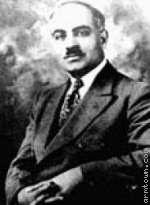
Primary Documents: Bryce Report into the Armenian Massacre, October 1915
Reproduced below is an extract from the text of the official British Government report into the Armenian Massacres conducted by Turkey during April-December 1915. The report, published while the massacres were still in progress (in October 1915) was produced by James Bryce, who had earlier published a report investigating alleged German atrocities in Belgium shortly after the war began in August 1914.
In his report Lord Bryce clearly indicted the present Turkish government as having deliberately set itself upon a policy of extermination of the Ottoman Empire's Armenian population.
British Government Report on the Armenian Massacres of April-December 1915 by Lord Bryce
I am grieved to say that such information as has reached me from several quarters goes to show that the number of those who have perished in Armenia is very large. It has been estimated at the figure of 800,000.
Though hoping that figure to be beyond the mark, I cannot venture to pronounce it incredible, for there has been an unparalleled destruction of life all over the country from the frontiers of Persia to the Sea of Marmora, only a very few of the cities of the Aegean coast having escaped.
This is so, because the proceedings taken have been so carefully premeditated and systematically carried out, with a ruthless efficiency previously unknown among the Turks. The massacres are the result of a policy which, as far as can be ascertained, has been entertained for some considerable time by the gang of unscrupulous adventurers in possession of the Government of the Turkish Empire.
They hesitated to put it in practice until they thought the favourable moment had come, and that moment seems to have arrived about the month of April, 1915. That was the time when these orders were issued, orders which came down in every case from Constantinople, and which the officials found themselves obliged to carry out on pain of dismissal.
There was no Moslem passion against the Armenian Christians. All was done by the will of the Government, and done not from any religious fanaticism, but simply be cause they wished, for reasons purely political, to get rid of a non-Moslem element which impaired the homogeneity of the Empire, and constituted an element that might not always submit to oppression.
All that I have learned confirms what has already been said elsewhere, that there is no reason to believe that in this case Musulman fanaticism came into play at all. So far as can be made out, though of course the baser natures have welcomed and used the opportunities for plunder which slaughter and deportations afford, these massacres have been viewed by the better sort of religious Moslems with horror rather than with sympathy. It would be too much to say that they have often attempted to interfere, but at any rate they do not seem to have shown approval of the conduct of the Turkish Government.
There is nothing in the precepts of Islam which justifies the slaughter which has been perpetrated. I am told on good authority that high Moslem religious authorities condemned the massacres ordered by Abdul Hamid, and these are far more atrocious. In some cases the governors, being pious and humane men, refused to execute the orders that had reached them, and endeavoured to give what protection they could to the unfortunate Armenians. In two cases I have heard of the governors being immediately dismissed for refusing to obey the orders. Others more pliant were substituted, and the massacres were carried out.
As I have said, the procedure was exceedingly systematic. The whole Armenian population of each town or village was cleared out, by a house-to-house search. Every inmate was driven into the street. Some of the men were thrown into prison, where they were put to death, sometimes with torture; the rest of the men, with the women and children, were marched out of the town. When they had got some little distance they were separated, the men being taken to some place among the hills, where the soldiers, or the Kurdish tribes who were called in to help in the work of slaughter, dispatched them by shooting or bayoneting.
The women and children and old men were sent off under convoy of the lowest kinds of soldiers - many of them just drawn from gaols - to their distant destination, which was sometimes one of the unhealthy districts in the centre of Asia Minor, but more frequently the large desert in the province of Der el Zor, which lies east of Aleppo, in the direction of the Euphrates. They were driven along by the soldiers day after day, all on foot, beaten or left behind to perish if they could not keep up with the caravan; many fell by the way, and many died of hunger.
No provisions were given them by the Turkish Government, and they had already been robbed of everything they possessed. Not a few of the women were stripped naked and made to travel in that condition beneath a burning sun. Some of the mothers went mad and threw away their children, being unable to carry them further.
The caravan route was marked by a line of corpses, and comparatively few seem to have arrived at the destinations which had been prescribed for them - chosen, no doubt, because return was impossible and because there was little prospect that any would survive their hardships. I have had circumstantial accounts of these deportations which bear internal evidence of being veracious, and I was told by an American friend who has lately returned from Constantinople that he had heard accounts at Constantinople confirming fully those which had come to me, and that what had struck him was the comparative calmness with which these atrocities were detailed by those who had first-hand knowledge of them.
Things which we find scarcely credible excite little surprise in Turkey. Massacre was the order of the day as in Eastern Rumelia in 1876, and, in 1895-6, in Asiatic Turkey.
When the Armenian population was driven from its homes, many of the women were not killed, but reserved for a more humiliating fate. They were mostly seized by Turkish officers or civilian officials, and consigned to their harems. Others were sold in the market, but only to a Moslem purchaser, for they were to be made Moslems by force.
Never again would they see parents or husbands these Christian women condemned at one stroke to slavery, shame and apostasy.
The boys and girls were also very largely sold into slavery, at prices sometimes of only ten to twelve shillings, while other boys of tender age were delivered to dervishes, to be carried off to a sort of dervish monastery, and there forced to become Musulmans.
To give one instance of the thorough and remorseless way in which the massacres were carried out, it may suffice to refer to the case of Trebizond, a case vouched for by the Italian Consul who was present when the slaughter was carried out, his country not having then declared war against Turkey.
Orders came from Constantinople that all the Armenian Christians in Trebizond were to be killed. Many of the Moslems tried to save their Christian neighbours, and offered them shelter in their houses, but the Turkish authorities were implacable.
Obeying the orders which they had received, they hunted out all the Christians, gathered them together, and drove a great crowd of them down the streets of Trebizond, past the fortress, to the edge of the sea. There they were all put on board sailing boats, carried out some distance on the Black Sea, and there thrown overboard and drowned.
Nearly the whole Armenian population of from 8,000 to 10,000 were destroyed - some in this way, some by slaughter, some by being sent to death elsewhere. After that, any other story becomes credible; and I am sorry to say that all the stories that I have received contain similar elements of horror, intensified in some cases by stories of shocking torture.
But the most pitiable case is not that of those whose misery was ended by swift death, but of those unfortunate women who, after their husbands had been killed and their daughters violated, were driven out with their young children to perish in the desert where they have no sustenance, and where they are the victims of the wild Arab tribes around them.
It would seem that three-fourths or four-fifths of the whole nation has been wiped out, and there is no case in history, certainly not since the time of Tamerlane, in which any crime so hideous and upon so large a scale has been recorded.
Let me add, because this is of some importance in view of the excuses which the German Government put forward, and which their Ambassador in Washington is stated to have given, when he talked about "the suppression of riots," for the conduct of those who were their allies, that there is no ground for the suggestion that there had been any rising on the part of the Armenians.
A certain number of Armenian volunteers fought on the side of the Russians in the Caucasian Army, but they came from the Armenian population of Trans-Caucasia. It may be that some few Armenians crossed the frontier in order to fight alongside their Armenian brethren in Trans-Caucasia for Russia, but at any rate, the volunteer corps which rendered such brilliant service to the Russian Army in the first part of the war was composed of Russian Armenians living in the Caucasus.
Wherever the Armenians, almost wholly unarmed as they were, have fought, they have fought in self-defence to defend their families and themselves from the cruelty of the ruffians who constitute what is called the Government of the country. There is no excuse whatever upon any such ground as some German authorities and newspapers allege, for the conduct of the Turkish Government.
Their policy of slaughter and deportation has been wanton and unprovoked. It appears to be simply an application of the maxim once enunciated by Sultan Abdul Ilamid: "The way to get rid of the Armenian question is to get rid of the Armenians"; and the policy of extermination has been carried out with far more thoroughness and with far more bloodthirsty completeness by the present heads of the Turkish Administration-they describe themselves as the Committee of Union and Progress - than it was in the time of Abdul Hamid.
Even if the statistics were more abundant and more eloquent still, they might fail to convey to our imagination the actuality of what has happened. A nation blotted out! It is easy to say it with the lips, more difficult to realize what it means, for it is something totally beyond our experience.
Perhaps nothing brings it home more crushingly than the record which we have of one little community of sensitive, refined Armenian people, and of the terrible fates by which they were individually overtaken. They were the members of an educational establishment in a certain Anatolian town, which was endowed and directed by a society of foreign missionaries; and the following is taken directly from a letter which was written by the President of the College after the blow had fallen.
I shall try to banish from my mind for the time the sense of great personal sorrow because of losing hundreds of my friends here, and also my sense of utter defeat in being so unable to stop the awful tragedy or even mitigate to any degree its severity, and compel myself to give you concisely some of the cold facts of the past months as they relate themselves to the College. I do so with the hope that the possession of these concrete facts may help you to do something there for the handful of dependents still left to us here.
(i) Constituency: Approximately two-thirds of the girl pupils and six-sevenths of the boys have been taken away to death, exile or Moslem homes.
(ii) Professors: Four gone, three left, as follows:Professor A., served College 35 years. Professor of Turkish and History. Besides previous trouble arrested May 1st without charge, hair of head, moustache and beard pulled out in vain effort to secure damaging confessions. Starved and hung by arms for a day and a night and severely beaten several times. Taken out towards Diyarbekir about June 10th and murdered in general massacre on the road.
Professor B., served College 33 years, studied at Ann Arbor. Professor of Mathematics, arrested about June 5th and shared Professor A.'s fate on the road.
Professor C., taken to witness a man beaten almost to death, became mentally deranged. Started with his family about July 5th into exile under guard and murdered beyond the first big town on the road. (Principal of Preparatory Department, studied at Princeton.) Served the College 20 years.
Professor D., served College 16 years, studied at Edinburgh, Professor of Mental and Moral Science. Arrested with Professor A. and suffered same tortures, also had three finger nails pulled out by the roots; killed in same massacre.
Professor E., served College 25 years, arrested May 1st, not tortured but sick in prison. Sent to Red Crescent Hospital and after paying large bribes is now free.
Professor F., served the College for over 15 years, studied in Stuttgart and Berlin, Professor of Music, escaped arrest and torture, and thus far escaped exile and death because of favour with the Kaim-makam secured by personal services rendered.
Professor G., served the College about 15 years, studied at Cornell and Yale (M.S.), Professor of Biology, arrested about June 5th, beaten about the hands, body and head with a stick by the Kaim-makam himself, who, when tired, called on all who loved religion and the nation to continue the beating; after a period of insensibility in a dark closet, taken to the Red Crescent Hospital with a broken finger and serious bruises.
(iii) Instructors, Male: Four reported killed on the road in various massacres, whose average term of service is eight years. Three not heard from, probably killed on the road, average term of service in the College four years.
Two sick in Missionary Hospital.One in exile.One engaged in cabinet work for the Kaim-makam, free.One, owner of house occupied by the Kaim-makam, free.
(iv) Instructors, Female:One reported killed in Chunkoosh, served the College over twenty years.One reported taken to a Turkish harem.Three not heard from.Four started out as exiles.Ten free.
Of the Armenian people as a whole we may put an estimate that three-fourths are gone, and this three-fourths includes the leaders in every walk of life, merchants, professional men, preachers, bishops and government officials.
I have said enough. Our hearts are sick with the sights and stories of abject terror and suffering. The extermination of the race seems to be the objective, and the means employed are more fiendish than could be concocted locally. The orders are from headquarters, and any reprieve must be from the same source.
http://www.firstworldwar.com/source/brycereport_armenia.htm
Friday, April 18, 2008

Who's Who: Lord Bryce

Who's Who: Lord Bryce
Viscount James Bryce (1838-1922) was responsible for producing the influential Bryce Report into alleged German atrocities in occupied Belgium during 1914 and a subsequent report on the Armenian Massacres conducted by the Turkish government.
Following an education at Glasgow University and then at Oxford, Bryce practised law in London before taking up a professorship of civil law at Oxford. It was during this period that Bryce established a reputation as a notable historian, his works including History of the Holy Roman Empire, published in 1864.
Entering British politics Bryce established himself as a leading Liberal, serving as President of the Board of Trade and Chief Secretary to Ireland. His private travels through Russia to Arafat resulted in the publication of Transcaucasia and Ararat in 1878. Ten years later he published The American Commonwealth, in which he expressed his views on sociology and philosophy.
From 1907-13 Bryce served as Britain's highly respected Ambassador to the U.S., a popularity born out of his deep knowledge of and fondness for the United States.
Thus Bryce's appointment towards the close of 1914 by British Prime Minister Herbert Asquith to investigate reports of alleged German barbarity towards civilians in occupied Belgium was widely welcomed. His report, published the following May (Report of the Committee on Alleged German Outrages), was clear in its condemnation of the German Army's conduct in Belgium.
In spite of the report's tendency to highlight the more extreme examples of German rule in Belgium - and to cite unreliable evidence, which led to the report's being largely discredited in the immediate post-war years - it was viewed as credible in the United States, with consequent damage to German interests in Washington.
Publishing Modern Democracies in 1921, James Bryce died in 1922.
Following an education at Glasgow University and then at Oxford, Bryce practised law in London before taking up a professorship of civil law at Oxford. It was during this period that Bryce established a reputation as a notable historian, his works including History of the Holy Roman Empire, published in 1864.
Entering British politics Bryce established himself as a leading Liberal, serving as President of the Board of Trade and Chief Secretary to Ireland. His private travels through Russia to Arafat resulted in the publication of Transcaucasia and Ararat in 1878. Ten years later he published The American Commonwealth, in which he expressed his views on sociology and philosophy.
From 1907-13 Bryce served as Britain's highly respected Ambassador to the U.S., a popularity born out of his deep knowledge of and fondness for the United States.
Thus Bryce's appointment towards the close of 1914 by British Prime Minister Herbert Asquith to investigate reports of alleged German barbarity towards civilians in occupied Belgium was widely welcomed. His report, published the following May (Report of the Committee on Alleged German Outrages), was clear in its condemnation of the German Army's conduct in Belgium.
In spite of the report's tendency to highlight the more extreme examples of German rule in Belgium - and to cite unreliable evidence, which led to the report's being largely discredited in the immediate post-war years - it was viewed as credible in the United States, with consequent damage to German interests in Washington.
Publishing Modern Democracies in 1921, James Bryce died in 1922.
The Armenian Genocide and Turkey's attempt to Deny It
The following is an excerpt from an article by Roger W. Smith (College of William and Mary Williamsburg, Virginia), Eric Markusen (Southwest State University Marshall, Minnesota), and Robert Jay Lifton (The City University of New York) titled “Professional Ethics and Denial of the Armenian Genocide”.
The Armenian Genocide and Turkey's Attempt to Deny It
From 1915 to 1917 the Young Turk regime in the Ottoman Empire carried out a systematic, premeditated, centrally planned genocide against the Armenian people. One of the documents authenticated by Turkish authorities in 1919 is a telegram sent in June 1915 by Dr. Sakir, one of the leaders of the secret organization that carried out the planning and implementation of the Genocide. He asks the provincial party official who is responsible for carrying out the deportations and massacres of Armenians within his district: "Are the Armenians, who are being dispatched from there, being liquidated? Are those harmful persons whom you inform us you are exiling and banishing, being exterminated, or are they being merely dispatched and exiled? Answer explicitly...."
The evidence of intent is backed also by the outcome of the actions against the Armenians: it is inconceivable that over a million persons could have died due to even a badly flawed effort at resettlement. Moreover, the pattern of destruction was repeated over and over in different parts of Turkey, many of them far from any war zone; such repetition could only have come from a central design. Further, the reward structure was geared toward destruction of the Christian minority: provincial governors and officials who refused to carry out orders to annihilate the Armenians were summarily replaced.
[Section omitted: A summary of key events of the Armenian Genocide.]
More than one million Armenians perished as the result of execution, starvation, disease, the harsh environment, and physical abuse. A people who lived in eastern Turkey for nearly 3,000 years lost its homeland and was profoundly decimated in the first large-scale genocide of the twentieth century. At the beginning of 1915 there were some two million Armenians within Turkey; today there are fewer than 60,000.
Despite the vast amount of evidence that points to the historical reality of the Armenian Genocide, eyewitness accounts, official archives, photographic evidence, the reports of diplomats, and the testimony of survivors, denial of the Armenian Genocide by successive regimes in Turkey has gone on from 1915 to the present.
The basic argument of denial has remained the same, it never happened, Turkey is not responsible, the term "genocide" does not apply. The tactics of denial, however, have shifted over the years. In the period immediately after World War I the tactic was to find scapegoats to blame for what was said to be only a security measure that had gone awry due to unscrupulous officials, Kurds, and common criminals. This was followed by an attempt to avoid the whole issue, with silence, diplomatic efforts, and political pressure used where possible. In the 1930s, for example, Turkey pressured the U.S. State Department into preventing MGM Studios from producing a film based on Franz Werfel's The Forty Days of Musa Dagh, a book that depicted aspects of the Genocide in a district located west of Antioch on the Mediterranean Sea, far from the Russian front.
In the 1960s, prompted by the worldwide commemoration of the fiftieth anniversary of the Genocide, efforts were made to influence journalists, teachers, and public officials by telling "the other side of the story." Foreign scholars were encouraged to revise the record of genocide, presenting an account largely blaming the Armenians or, in another version, wartime conditions which claimed the lives of more Turks than Armenians. Thereafter, Turkey tried to prohibit any mention of the Genocide in a United Nations report and was successful in its pressure on the Reagan and Bush administrations in defeating Congressional resolutions that would have designated April 24 as a national day of remembrance of the Armenian Genocide. The Turkish government has also attempted to exclude any mention of the Genocide from American textbooks. Stronger efforts still have been made to prevent any discussion of the 1915 genocide being formally included in the social studies curriculum as part of Holocaust and genocide studies.
There have also been attempts by the Turkish government to disrupt academic conferences and public discussions of the Genocide. A notable example was the attempt by Turkish officials to force cancellation of a conference in Tel Aviv in 1982 if the Armenian Genocide were to be discussed, demands backed up with threats to the safety of Jews in Turkey. The U.S. Holocaust Memorial Council reported similar threats over plans to include references to the Armenian Genocide within the interpretive framework of the Holocaust Memorial Museum in Washington. At the same time, Turkey has sought to make an absolute distinction between the Holocaust and the Armenian Genocide, defining the latter as "alleged" or "so-called." The documents we have, however, show that, in private, such labeling drops off.
Finally, in the 1980s the Turkish government supported the establishment of "institutes", whose apparent purpose was to further research on Turkish history and culture. At least one also was used to further denial of Turkish genocide and otherwise improve Turkey's image in the West.
####
In addition to continuing the denial efforts described in the article above, presently the Turkish government has hired former Congressmen to lobby on its behalf. Former Reps. Bob Livingston (R-LA) and Gerald Solomon (R-NY), who are each paid $700,000 as well as former Rep. Stephen Solarz (D-NY) who is paid $400,000, are aggressively attempting to rally Republican and Democratic opposition against official U.S. recognition of the Armenian Genocide.
The Armenian Genocide and Turkey's Attempt to Deny It
From 1915 to 1917 the Young Turk regime in the Ottoman Empire carried out a systematic, premeditated, centrally planned genocide against the Armenian people. One of the documents authenticated by Turkish authorities in 1919 is a telegram sent in June 1915 by Dr. Sakir, one of the leaders of the secret organization that carried out the planning and implementation of the Genocide. He asks the provincial party official who is responsible for carrying out the deportations and massacres of Armenians within his district: "Are the Armenians, who are being dispatched from there, being liquidated? Are those harmful persons whom you inform us you are exiling and banishing, being exterminated, or are they being merely dispatched and exiled? Answer explicitly...."
The evidence of intent is backed also by the outcome of the actions against the Armenians: it is inconceivable that over a million persons could have died due to even a badly flawed effort at resettlement. Moreover, the pattern of destruction was repeated over and over in different parts of Turkey, many of them far from any war zone; such repetition could only have come from a central design. Further, the reward structure was geared toward destruction of the Christian minority: provincial governors and officials who refused to carry out orders to annihilate the Armenians were summarily replaced.
[Section omitted: A summary of key events of the Armenian Genocide.]
More than one million Armenians perished as the result of execution, starvation, disease, the harsh environment, and physical abuse. A people who lived in eastern Turkey for nearly 3,000 years lost its homeland and was profoundly decimated in the first large-scale genocide of the twentieth century. At the beginning of 1915 there were some two million Armenians within Turkey; today there are fewer than 60,000.
Despite the vast amount of evidence that points to the historical reality of the Armenian Genocide, eyewitness accounts, official archives, photographic evidence, the reports of diplomats, and the testimony of survivors, denial of the Armenian Genocide by successive regimes in Turkey has gone on from 1915 to the present.
The basic argument of denial has remained the same, it never happened, Turkey is not responsible, the term "genocide" does not apply. The tactics of denial, however, have shifted over the years. In the period immediately after World War I the tactic was to find scapegoats to blame for what was said to be only a security measure that had gone awry due to unscrupulous officials, Kurds, and common criminals. This was followed by an attempt to avoid the whole issue, with silence, diplomatic efforts, and political pressure used where possible. In the 1930s, for example, Turkey pressured the U.S. State Department into preventing MGM Studios from producing a film based on Franz Werfel's The Forty Days of Musa Dagh, a book that depicted aspects of the Genocide in a district located west of Antioch on the Mediterranean Sea, far from the Russian front.
In the 1960s, prompted by the worldwide commemoration of the fiftieth anniversary of the Genocide, efforts were made to influence journalists, teachers, and public officials by telling "the other side of the story." Foreign scholars were encouraged to revise the record of genocide, presenting an account largely blaming the Armenians or, in another version, wartime conditions which claimed the lives of more Turks than Armenians. Thereafter, Turkey tried to prohibit any mention of the Genocide in a United Nations report and was successful in its pressure on the Reagan and Bush administrations in defeating Congressional resolutions that would have designated April 24 as a national day of remembrance of the Armenian Genocide. The Turkish government has also attempted to exclude any mention of the Genocide from American textbooks. Stronger efforts still have been made to prevent any discussion of the 1915 genocide being formally included in the social studies curriculum as part of Holocaust and genocide studies.
There have also been attempts by the Turkish government to disrupt academic conferences and public discussions of the Genocide. A notable example was the attempt by Turkish officials to force cancellation of a conference in Tel Aviv in 1982 if the Armenian Genocide were to be discussed, demands backed up with threats to the safety of Jews in Turkey. The U.S. Holocaust Memorial Council reported similar threats over plans to include references to the Armenian Genocide within the interpretive framework of the Holocaust Memorial Museum in Washington. At the same time, Turkey has sought to make an absolute distinction between the Holocaust and the Armenian Genocide, defining the latter as "alleged" or "so-called." The documents we have, however, show that, in private, such labeling drops off.
Finally, in the 1980s the Turkish government supported the establishment of "institutes", whose apparent purpose was to further research on Turkish history and culture. At least one also was used to further denial of Turkish genocide and otherwise improve Turkey's image in the West.
####
In addition to continuing the denial efforts described in the article above, presently the Turkish government has hired former Congressmen to lobby on its behalf. Former Reps. Bob Livingston (R-LA) and Gerald Solomon (R-NY), who are each paid $700,000 as well as former Rep. Stephen Solarz (D-NY) who is paid $400,000, are aggressively attempting to rally Republican and Democratic opposition against official U.S. recognition of the Armenian Genocide.
Cleansing of Archives
The article titled "Countless Archives Destroyed" by Ayshe Hur reminded me destruction of Armenian Genocide related documents. Systematic destruction of documents appears to be a significant part of our culture. The Sabah daily, in its November 7, 1918 issue states that documents related to Armenian Genocide, sought after by the government, could not be found, and it furthers claims that Talat Pasha and his entourage, before they left the government, quite possibly destroyed the orders related to Armenian genocide in entirety. The news article reflects the truth. Similarly, on May 1919, during proceedings of the Court Martial Hearings of the Union and Progress Party (CUP), prosecutors declare that documents belonging to both Special Organization and to the Central Committee of the Committee for Union and Progress were stolen. The military prosecutor furthermore informs the hearing that Police Chief of the period, Aziz Bey, testified that Talat Pasha, before his resignation, took several files with him from his office and never returned them (Official Gazette 3540).
Likewise, several memoirs of the era tell that, before he escaped to overseas, Talat Pasha went to a friend’s seaside estate by Arnavutkoy with a full suitcase of documents and he burned all these documents in a fireplace at the basement of the estate (Enver Pasha by Shevket Sureyya Aydemir. Volume 3, Page 468). Mithad Shukru, K. Talat and Ziya Gokalp, during the main prosecution of CUP leaders at various court sessions (most specifically at second and fifth sessions), testified that Central Committee of CUP documents were taken by Dr. Nazim (Official Gazette 3540, 3543, 3554). It was not only CUP officials who took documents personally, several German Officers also stole documents. Hans F.L. Von Seeckt, who during the war was the Ottoman Chief of Staff, took a significant portion of the Ottoman War Ministry documents with him upon his return to Germany. The chief of Cabinet, Izzet Pasha, protested the situation and demanded the return of the documents. Berlin promised to return of the documents but never fulfiled the promise. (AA Turkei, 158/21. A48179, The embassador’s telegram dated November 11, 1918).
Read, destroy
There is a significant point here that the Sabah newspaper could not be aware of it. For some documents, as they were sent to the provinces, concurrent orders were issued to burn or destroy…There happens to be an encrypted telegram left in the Ottoman Archives dated July 22, 1915 sent by the General Directorate of Police and signed by Talat Pasha. The telegram tells how to deal with the converts in the caravans of exiles and further instructs that "after the reading of the related personnel to take the telegram out of post office and destroy" (Court Martial Proceedings, encrypted 54,100). In our possession there are other documents proving that orders were sent to the provinces to burn all the documents they have. For example, in the above mentioned accusation, it is told that the regional governor of Der Zor, Ali Suat was ordered to destroy the telegram after reading it. Similarly, in another court case, at the third session of Yozgat Court Martials, the presiding judge reads the testimony of Provincial Governor Kemal, taken in front of Mazhar Investigative Commission. In his testimony, Kemal says that he had received telegrams to be burned after his read (Ikdam, February 11, 1919)
On the July 3rd, 1919 session of the court case on the Ottoman Cabinet, former Minister of Telecommunication, Huseyin Hasim, testifies that documents of the War Department were burned. Furthermore, on the 5th session of the court, he admits that orders to burn were sent to Catalca (Official Gazette 3571 and 3573). For this reason alone, a separate court case is opened for the former deputy director of Catalca Post Office Osman Nuri Efendi. The court starts on August 4, 1919. The accusation is burning documents. In his defense statement, the accuser claims to burn documents on orders. He elaborates, " My superiors, within their legitimate authority, ordered me to burn documents from a certain date to another date, therefore I burned them." The outcome of this court case is not clear (See Alemdar Newspaper, August 5 and 6, 1919).
Memoirs of Refik Halid
The burning of the documents continued after the war was lost. On Oct. 14, 1918 Izzet Pasha forms a new cabinet, where he also assumes the responsibility of War Ministry. He sends an immediate order to the Special Organization’s Head Administrator to immediately stop all activities and destroy archives (quoted by Bilge Criss based on Husamettin Erturk – Istanbul Under Allied Rule, page 147). Ahmet Esat (Esat Uras by his better known name) declares to the British officials that a meeting had been held on the destruction of Armenians and he has in his possession the handwritten minutes of it, he later tries to sell these minutes. He gets arrested and in his testimony he claims, " Right before the armistice, the government officials went to archives daily every night and destroyed most of the documents." (Foreign Office Reports 371/4172/31307, Heathcotee Smith’s 4.2.1919 dated report).
Refik Halid Karay, other than being an influential literary figure and newsman, was the general administrator of the Postal and Telegraphic Services during the armistice. He published his memoirs about this era under the name of "Minelbab Ilelmihrab/Memoirs of Armistice Era." While his memoirs were being published in a magazine named "Aydede", Sadik Durakan, who for many years served in the Post Office, wrote him a letter. Karay includes the letter in his book. Following is a short section from this letter: " I wish to tell you an incident I witnessed during the armistice. As you know, after the Mondros Armistice, the Allied forces started to enter our country from various directions and started to occupy the country piece by piece. During the occupation, in order to prevent documentation in the central post offices to fall into enemy hands, Mehmed Emin Bey sent a telegram to all Central Post Offices and asked them to destroy all official documentation, telegrams and their duplicates in totality (R.H Karay, Minelbab Ilelmihrab, pages 271-2).
Some of these telegrams are captured by the British before they reach regional offices. For example, in June 1919 a telegram from Interior Ministry to the Governor of Antep, which is intercepted by the British, orders all telegrams between 1914 and 1918 to be destroyed. The Foreign Ministry sends an official protestation letter to the British Occupational Forces, but it admits such an order was given (FO371/4174/102 551; files 108-111).
The destruction of documents was not solely performed by the government officials. Individuals also have the culture of destroying documents remained in their possession. One of the defendants of the 1926 Ankara National Liberation Court , which was assembled to judge the Izmir assassination attempt, Kor (Blind) Ali Ihsan Bey, a member of Istanbul’s CUP General Center, admits burning all the documents in his possession (1926 Ankara National Liberation Court proceedings). People, who burned documents in their possession, did not hesitate to tell their actions in their memoirs during the following years. I would like to cite two examples. An important CUP leader, Ali Munif Bey, was a provincial district head and governor who also served in the CUP cabinet as the Ministry of Public Works. Ali Munif was arrested for his involvement in the Adana massacres and later exiled to Malatya. He says the following for the documents that gave up his guilt: "In reality even though I had destroyed more important documentation, I had left this in one of the pockets of my suitcase. The document that I had forgotten to destroy was being used to incriminate me (Memoirs of Ali Munif Bey by Taha Toros, pages 96-7).
TANER AKÇAM
Likewise, several memoirs of the era tell that, before he escaped to overseas, Talat Pasha went to a friend’s seaside estate by Arnavutkoy with a full suitcase of documents and he burned all these documents in a fireplace at the basement of the estate (Enver Pasha by Shevket Sureyya Aydemir. Volume 3, Page 468). Mithad Shukru, K. Talat and Ziya Gokalp, during the main prosecution of CUP leaders at various court sessions (most specifically at second and fifth sessions), testified that Central Committee of CUP documents were taken by Dr. Nazim (Official Gazette 3540, 3543, 3554). It was not only CUP officials who took documents personally, several German Officers also stole documents. Hans F.L. Von Seeckt, who during the war was the Ottoman Chief of Staff, took a significant portion of the Ottoman War Ministry documents with him upon his return to Germany. The chief of Cabinet, Izzet Pasha, protested the situation and demanded the return of the documents. Berlin promised to return of the documents but never fulfiled the promise. (AA Turkei, 158/21. A48179, The embassador’s telegram dated November 11, 1918).
Read, destroy
There is a significant point here that the Sabah newspaper could not be aware of it. For some documents, as they were sent to the provinces, concurrent orders were issued to burn or destroy…There happens to be an encrypted telegram left in the Ottoman Archives dated July 22, 1915 sent by the General Directorate of Police and signed by Talat Pasha. The telegram tells how to deal with the converts in the caravans of exiles and further instructs that "after the reading of the related personnel to take the telegram out of post office and destroy" (Court Martial Proceedings, encrypted 54,100). In our possession there are other documents proving that orders were sent to the provinces to burn all the documents they have. For example, in the above mentioned accusation, it is told that the regional governor of Der Zor, Ali Suat was ordered to destroy the telegram after reading it. Similarly, in another court case, at the third session of Yozgat Court Martials, the presiding judge reads the testimony of Provincial Governor Kemal, taken in front of Mazhar Investigative Commission. In his testimony, Kemal says that he had received telegrams to be burned after his read (Ikdam, February 11, 1919)
On the July 3rd, 1919 session of the court case on the Ottoman Cabinet, former Minister of Telecommunication, Huseyin Hasim, testifies that documents of the War Department were burned. Furthermore, on the 5th session of the court, he admits that orders to burn were sent to Catalca (Official Gazette 3571 and 3573). For this reason alone, a separate court case is opened for the former deputy director of Catalca Post Office Osman Nuri Efendi. The court starts on August 4, 1919. The accusation is burning documents. In his defense statement, the accuser claims to burn documents on orders. He elaborates, " My superiors, within their legitimate authority, ordered me to burn documents from a certain date to another date, therefore I burned them." The outcome of this court case is not clear (See Alemdar Newspaper, August 5 and 6, 1919).
Memoirs of Refik Halid
The burning of the documents continued after the war was lost. On Oct. 14, 1918 Izzet Pasha forms a new cabinet, where he also assumes the responsibility of War Ministry. He sends an immediate order to the Special Organization’s Head Administrator to immediately stop all activities and destroy archives (quoted by Bilge Criss based on Husamettin Erturk – Istanbul Under Allied Rule, page 147). Ahmet Esat (Esat Uras by his better known name) declares to the British officials that a meeting had been held on the destruction of Armenians and he has in his possession the handwritten minutes of it, he later tries to sell these minutes. He gets arrested and in his testimony he claims, " Right before the armistice, the government officials went to archives daily every night and destroyed most of the documents." (Foreign Office Reports 371/4172/31307, Heathcotee Smith’s 4.2.1919 dated report).
Refik Halid Karay, other than being an influential literary figure and newsman, was the general administrator of the Postal and Telegraphic Services during the armistice. He published his memoirs about this era under the name of "Minelbab Ilelmihrab/Memoirs of Armistice Era." While his memoirs were being published in a magazine named "Aydede", Sadik Durakan, who for many years served in the Post Office, wrote him a letter. Karay includes the letter in his book. Following is a short section from this letter: " I wish to tell you an incident I witnessed during the armistice. As you know, after the Mondros Armistice, the Allied forces started to enter our country from various directions and started to occupy the country piece by piece. During the occupation, in order to prevent documentation in the central post offices to fall into enemy hands, Mehmed Emin Bey sent a telegram to all Central Post Offices and asked them to destroy all official documentation, telegrams and their duplicates in totality (R.H Karay, Minelbab Ilelmihrab, pages 271-2).
Some of these telegrams are captured by the British before they reach regional offices. For example, in June 1919 a telegram from Interior Ministry to the Governor of Antep, which is intercepted by the British, orders all telegrams between 1914 and 1918 to be destroyed. The Foreign Ministry sends an official protestation letter to the British Occupational Forces, but it admits such an order was given (FO371/4174/102 551; files 108-111).
The destruction of documents was not solely performed by the government officials. Individuals also have the culture of destroying documents remained in their possession. One of the defendants of the 1926 Ankara National Liberation Court , which was assembled to judge the Izmir assassination attempt, Kor (Blind) Ali Ihsan Bey, a member of Istanbul’s CUP General Center, admits burning all the documents in his possession (1926 Ankara National Liberation Court proceedings). People, who burned documents in their possession, did not hesitate to tell their actions in their memoirs during the following years. I would like to cite two examples. An important CUP leader, Ali Munif Bey, was a provincial district head and governor who also served in the CUP cabinet as the Ministry of Public Works. Ali Munif was arrested for his involvement in the Adana massacres and later exiled to Malatya. He says the following for the documents that gave up his guilt: "In reality even though I had destroyed more important documentation, I had left this in one of the pockets of my suitcase. The document that I had forgotten to destroy was being used to incriminate me (Memoirs of Ali Munif Bey by Taha Toros, pages 96-7).
TANER AKÇAM
Remembering a dark chapter in Turkish history
REMEMBERING A DARK CHAPTER IN TURKISH HISTORY
CAMBRIDGE -- Henry Morgenthau III sits in his living room, surrounded by mementos of his family, and speaks of the great goal of his grandfather's life: ''He wanted to think of himself as fully American."
Morgenthau's immigrant grandfather, who served as US ambassador to Turkey between 1913 and 1916, strived to establish the German-Jewish Morgenthaus in the American aristocracy almost as assiduously as Joseph P. Kennedy Sr. strived to establish his Irish-Catholic family in the American pantheon. The Morgenthaus acquired top-notch educations, a grand home in the Hudson Valley near the Roosevelts, and a seemingly permanent seat at the tables of power.
The Morgenthaus ascended the way most immigrants did, by assimilation. Henry III still remembers his grandfather reciting rhymes to try to rid himself of the last vestige of a German accent-- his difficulty pronouncing the letters ''th." The first Henry Morgenthau distanced himself from Zionism, fearful that it would prompt suspicions of dual loyalties among American Jews.
But while assuming the posture of the Protestant Yankee elites, the Morgenthaus never forgot their shared ancestry with the refugees, displaced peoples, and immigrants of the world. That is why they occupy a unique niche among America's self-made aristocracy: Both Henry Morgenthau Sr. and his son Henry Morgenthau Jr. are heroes to millions overseas for trying to intervene in the first two genocides of the 20th century, the Turkish slaughter of Armenians in 1915 and the Nazi extermination of European Jews.
In the United States, the recent growth of Holocaust studies has cast a new spotlight on the accomplishments of both men, especially Henry Morgenthau Sr. As the 90th anniversary of the date marking the Armenian genocide arrives next month, Armenian-Americans will be quoting from the diplomatic cables sent back by Ambassador Morgenthau as proof of slaughters of Armenians at the hands of Ottoman Turks that the Turkish government has yet to acknowledge.
In a book written in 1918, Morgenthau sought to separate the killings of Armenians from past forms of civil strife, writing of ''the massacre of a nation" long before the term genocide was invented. Collecting eyewitness accounts from US consuls at various locations in the Ottoman Empire, which then included Palestine and Armenia, Morgenthau warned of an unceasing campaign of murder by Turks.
''The cables that were sent back and forth were very alarming -- a graphic, florid description of what was going on -- and the State Department's response was just to let him go it alone," explained Henry Morgenthau III.
Henry Morgenthau Sr. never wanted to be ambassador to Turkey, which was then the segregated Jewish seat of the diplomatic corps. He had higher ambitions.
Morgenthau had attached his hopes to Woodrow Wilson when the New Jersey governor was a long-shot presidential candidate in 1912. Morgenthau, who had made his fortune on Wall Street, chaired Wilson's campaign finance committee. As a reward, Morgenthau expected nothing less than a Cabinet post -- but Wilson did not come through. Instead, according to Henry III, Wilson urged Morgenthau to take the post in Constantinople, now known as Istanbul, as a way of helping ''your people."
Morgenthau did get to help Jews -- funneling American contributions to help rescue Jews in Palestine from starvation -- but his greatest contribution was calling attention to the plight of the Armenians. After serving as ambassador for three years, he went on to found the largest private relief organization for surviving Armenians.
By 1932, when he began raising money for the first presidential run of New York Governor Franklin D. Roosevelt, Ambassador Morgenthau's ambitions had been channeled into his son, Henry Jr.
Roosevelt named the younger Morgenthau to be secretary of the treasury, a post he held for 11 years, during which time he was instrumental in financing the military buildup during World War II.
But Henry Morgenthau Jr. was also the leading voice calling attention to the systematic killing of Jews, when the State Department refused to highlight the issue. Morgenthau had his Treasury staff research their own report on the Holocaust, declaring ''the acquiescence of this government in the murder of the Jews." Without State Department approval, he used his personal friendship with Roosevelt to prod the president to take action.
Roosevelt eventually pressured Hungary to halt any transfers of Jews to the Nazis, saving 200,000 people, but he did not heed Morgenthau's pleas to bomb Auschwitz. Henry Morgenthau Jr. went on to help establish Israel, serving as chairman of the United Jewish Appeal, among other posts.
Later generations of immigrants, holding close to their ethnic and religious identities, came to view assimilation with suspicion, as though those who aspired to Ivy League pedigrees, Dutchess County addresses, and fancy New York men's clubs were merely trying to disappear into another culture.
The Morgenthaus disprove that theory. In fact, they were far more marked by their religion because they traveled in Protestant circles, and their values were strengthened for being challenged every day. Henry Morgenthau III, who was close to both his father and grandfather, became a public-television pioneer, producing a series called ''Prospects of Mankind" featuring his mother's good friend, Eleanor Roosevelt. Now in his late 80s, Morgenthau has become the family historian.
His younger brother Robert Morgenthau is the legendary Manhattan district attorney, most noteworthy in recent years for refusing to seek the death penalty, even where allowed under state law, because he believes it is unfairly applied. Now, on the 90th anniversary of the Armenian genocide, Henry Morgenthau III is still pressing his grandfather's cause, urging the Turks to acknowledge the massacres.
''Ninety years after the 1915 genocide, there are no living individuals who can be held responsible," Morgenthau said. ''But from the standpoint of both nations, Armenia and Turkey, it would be not only the right thing but a satisfying thing for those people to achieve healing."
Peter S. Canellos is the Globe's Washington bureau chief. National Perspective is his weekly analysis of events in the capital and beyond.
Boston Globe, MA
March 29 2005
CAMBRIDGE -- Henry Morgenthau III sits in his living room, surrounded by mementos of his family, and speaks of the great goal of his grandfather's life: ''He wanted to think of himself as fully American."
Morgenthau's immigrant grandfather, who served as US ambassador to Turkey between 1913 and 1916, strived to establish the German-Jewish Morgenthaus in the American aristocracy almost as assiduously as Joseph P. Kennedy Sr. strived to establish his Irish-Catholic family in the American pantheon. The Morgenthaus acquired top-notch educations, a grand home in the Hudson Valley near the Roosevelts, and a seemingly permanent seat at the tables of power.
The Morgenthaus ascended the way most immigrants did, by assimilation. Henry III still remembers his grandfather reciting rhymes to try to rid himself of the last vestige of a German accent-- his difficulty pronouncing the letters ''th." The first Henry Morgenthau distanced himself from Zionism, fearful that it would prompt suspicions of dual loyalties among American Jews.
But while assuming the posture of the Protestant Yankee elites, the Morgenthaus never forgot their shared ancestry with the refugees, displaced peoples, and immigrants of the world. That is why they occupy a unique niche among America's self-made aristocracy: Both Henry Morgenthau Sr. and his son Henry Morgenthau Jr. are heroes to millions overseas for trying to intervene in the first two genocides of the 20th century, the Turkish slaughter of Armenians in 1915 and the Nazi extermination of European Jews.
In the United States, the recent growth of Holocaust studies has cast a new spotlight on the accomplishments of both men, especially Henry Morgenthau Sr. As the 90th anniversary of the date marking the Armenian genocide arrives next month, Armenian-Americans will be quoting from the diplomatic cables sent back by Ambassador Morgenthau as proof of slaughters of Armenians at the hands of Ottoman Turks that the Turkish government has yet to acknowledge.
In a book written in 1918, Morgenthau sought to separate the killings of Armenians from past forms of civil strife, writing of ''the massacre of a nation" long before the term genocide was invented. Collecting eyewitness accounts from US consuls at various locations in the Ottoman Empire, which then included Palestine and Armenia, Morgenthau warned of an unceasing campaign of murder by Turks.
''The cables that were sent back and forth were very alarming -- a graphic, florid description of what was going on -- and the State Department's response was just to let him go it alone," explained Henry Morgenthau III.
Henry Morgenthau Sr. never wanted to be ambassador to Turkey, which was then the segregated Jewish seat of the diplomatic corps. He had higher ambitions.
Morgenthau had attached his hopes to Woodrow Wilson when the New Jersey governor was a long-shot presidential candidate in 1912. Morgenthau, who had made his fortune on Wall Street, chaired Wilson's campaign finance committee. As a reward, Morgenthau expected nothing less than a Cabinet post -- but Wilson did not come through. Instead, according to Henry III, Wilson urged Morgenthau to take the post in Constantinople, now known as Istanbul, as a way of helping ''your people."
Morgenthau did get to help Jews -- funneling American contributions to help rescue Jews in Palestine from starvation -- but his greatest contribution was calling attention to the plight of the Armenians. After serving as ambassador for three years, he went on to found the largest private relief organization for surviving Armenians.
By 1932, when he began raising money for the first presidential run of New York Governor Franklin D. Roosevelt, Ambassador Morgenthau's ambitions had been channeled into his son, Henry Jr.
Roosevelt named the younger Morgenthau to be secretary of the treasury, a post he held for 11 years, during which time he was instrumental in financing the military buildup during World War II.
But Henry Morgenthau Jr. was also the leading voice calling attention to the systematic killing of Jews, when the State Department refused to highlight the issue. Morgenthau had his Treasury staff research their own report on the Holocaust, declaring ''the acquiescence of this government in the murder of the Jews." Without State Department approval, he used his personal friendship with Roosevelt to prod the president to take action.
Roosevelt eventually pressured Hungary to halt any transfers of Jews to the Nazis, saving 200,000 people, but he did not heed Morgenthau's pleas to bomb Auschwitz. Henry Morgenthau Jr. went on to help establish Israel, serving as chairman of the United Jewish Appeal, among other posts.
Later generations of immigrants, holding close to their ethnic and religious identities, came to view assimilation with suspicion, as though those who aspired to Ivy League pedigrees, Dutchess County addresses, and fancy New York men's clubs were merely trying to disappear into another culture.
The Morgenthaus disprove that theory. In fact, they were far more marked by their religion because they traveled in Protestant circles, and their values were strengthened for being challenged every day. Henry Morgenthau III, who was close to both his father and grandfather, became a public-television pioneer, producing a series called ''Prospects of Mankind" featuring his mother's good friend, Eleanor Roosevelt. Now in his late 80s, Morgenthau has become the family historian.
His younger brother Robert Morgenthau is the legendary Manhattan district attorney, most noteworthy in recent years for refusing to seek the death penalty, even where allowed under state law, because he believes it is unfairly applied. Now, on the 90th anniversary of the Armenian genocide, Henry Morgenthau III is still pressing his grandfather's cause, urging the Turks to acknowledge the massacres.
''Ninety years after the 1915 genocide, there are no living individuals who can be held responsible," Morgenthau said. ''But from the standpoint of both nations, Armenia and Turkey, it would be not only the right thing but a satisfying thing for those people to achieve healing."
Peter S. Canellos is the Globe's Washington bureau chief. National Perspective is his weekly analysis of events in the capital and beyond.
Boston Globe, MA
March 29 2005
Tuesday, April 15, 2008
Interview with Samantha Power
Interview with Samantha Power
Samantha Power is professor of practice of global leadership
and public policy at the Carr Center for Human Rights
Policy, where she was the founding executive director
(1998-2002). She is the recent author of Chasing the Flame:
Sergio Vieira de Mello and the Fight to Save the World (see our
review on p. 10). Her book, A Problem from Hell: America and
the Age of Genocide (New Republic Books) was awarded the
2003 Pulitzer Prize for GeneralNon-Fiction.
Power’s article in the New Yorker on the horrors in Darfur
won the 2005 National Magazine Award for Best Reporting.
In 2007, Power became a foreign policy columnist at Time magazine.
From 1993-96, she covered the wars in the former Yugoslavia
as a reporter for the U.S. News and World Report, the
Boston Globe and the New Republic. She remains a working journalist,
reporting from such places as Burundi, East Timor, Kosovo,
Rwanda, Sudan and Zimbabwe, and contributing to the Atlantic
Monthly, the New Yorker and the New York Review of Books.
Earlier this month, Power resigned from her position as senior
political advisor to presidential candidate Barack Obama.
The following interview with Samantha Power was conducted
for the documentary film “The Armenian Genocide,”
directed and produced by Emmy Award-winning producer
Andrew Goldberg of Two Cats Productions (www.twocatstv.com).
Short segments of the interview appeared in the documentary. It
is published here, in the Armenian Weekly, for the first time
and in its entirety. The Weekly would like to
thank Andrew Goldberg and Two Cats TV for this collaboration.
Q—Can you discuss where the actual word “genocide”
comes from, it’s Greek and Latin origins and so forth?
Samantha Power—“Genocide” is a hybrid between the
Greek genos for people or tribe, and the Latin cidere, cide, for
killing.
Q- Could you go into the history of the word and Raphael Lemkin?
S.P.—The word “genocide” was invented by Raphael
Lemkin, a Polish-Jew, who in the interwar period tried to mobilize
states and statesmen to care about what he saw as the imminent destruction of ethnic, national and religious groups. He was partially concerned
about the Jews but he also had concerns about other groups
that he felt were threatened around the world. So he tried to
get the League of Nations to take this issue seriously and to
ban this crime, which at the time he called “barbarity”—the
crime of the destruction of groups. He was ignored and in
some cases laughed and yawned out of the conference. He went
back to Poland and, six years later, Hitler invaded Poland, allegedly
declaring, “Who now remembers the annihilation of the
Armenians?” Lemkin lost 49 members of
his family in the Holocaust. Hespent his days during the Holocaust
trying to understand why in the build up to World War II,
he had been so unsuccessful in convincing states and statesmen
to care about what to him looked like the imminent
destruction of the Jews. He told himself that his number
one failing was that he didn’t have a word that
was commensurate to the gravity of what would become
Hitler’s crime. And so his notebooks were filled
with his efforts to find that word. He struggled to find a word that was commensurate with the horrors that had occurred against the Armenians in 1915, and then the ones that were
ongoing in World War II against the Jews. In 1941,
he came up with the word“genocide.”
Q—Why is it necessary
to use the word “genocide”
to describe what happened to the Armenians
in 1915?
S.P.—What the word
“genocide” connotes is a
systematic campaign of
destruction. If you simply
call the horrors of 1915
“crimes against humanity”
or “atrocities,” it doesn’t fully
convey just how methodical this
campaign of slaughter and deportation
really was. There are
very few paradigmatic cases of
genocide where you can really
see either through the words of
the perpetrators or through the
policies undertaken in pursuit of
the goal to annihilate a certain
group—in this case, the Armenian
community in the Ottoman
Empire. I think that’s why Armenians
and other historians
look at the record and can come
to no other conclusion than this
word “genocide” applies to this
methodical campaign of destruction.
At the time the atrocities
were being carried out, the perpetrators
boasted about what it
was they were trying to do:
They were going to solve the
Armenian problem by getting
rid of the Armenians. In the aftermath
of the atrocities of 1915,
perpetrators were prosecuted for
the crimes that they committed.
Now, the word “genocide” did
not exist then. It wouldn’t come
into existence for another 25
years. But there was widespread
knowledge that what had been
attempted was a campaign of
destruction, hence, genocide.
What is so tragic is that in the
wake of the Armenian horrors
and in the wake of the trials of
Turkish perpetrators, a blanket
of denial has smothered Turkey
and there’s no willingness to acknowledge
what was boasted
about at the time.
Q—What impact did the suffering
of the Armenians have on
Lemkin?
S.P.—In the 20’s and the 30’s,
Lemkin became a kind of amateur
historian of mass slaughter, and
the case that really moved him
was that of the Armenians. He
spent months and months just going
through the archives and trying
to understand how such a
crime could have been committed
in Europe. He was a great believer
in European civilization, and what
he encountered in the record was
what would later become known
as an orientalist framing of what
had occurred: The perpetrators
were these Turks and they
weren’t really Europeans. They
were tribal savages, Muslim
hordes, and Europe would never
suffer from anything quite like
that, it was argued. But as he studied
the records he understood that
the Armenian case offered great
insight into how genocides occur.
He understood the way in which
the Armenians were branded by
the Turkish government at the
time, and he saw the dehumanization
of Armenians as a community
and indeed how they lacked some
of the perks of people of Turkish
ethnicity and Muslim fate.
All this became very much a
part of his effort to understand
what the signals would be when a
regime was intent on wiping out
part of its population. In terms of
the genocide itself, he was struck
by the way in which the Turkish
government first went after the intellectuals
and the local leaders of
the Armenian communities in the
towns. He also made frequent reference
to the way in which the deportation
of Armenians became as
effective an implement of genocide
as those executions in the
town squares. He saw that you
could destroy a group not simply
by rounding up the men or
the leaders of the community
and hanging them or machinegunning
them, but by actually
deporting a group from a
country and, especially
in the Armenian case,
sending them into conditions
where there was
no way that they could
survive. So, you were
actually going to
achieve the same results
with a machine gun but
it was going to be much
cheaper and it was going
to draw much less
attention.
Q—What is the effect
of genocide denial?
S.P.—I think denial
is devastating both for
the victims or descendents
of victims on the
one hand and for the
descendents of perpetrator
societies on the
other. For victims or
their family members,
there just can’t be anything
worse than living
through the loss, the
obliteration of your livelihood,
your home, and
the systematic extermination
of your family—
extermination that is accompanied
by the taunt of “no one
will ever know,” “no one will
ever remember,” “no one will
ever believe you, even if you
make it out of here, no one will
believe you.”
So you live through all of
that, you make it out, you’ve
lost everything and then you
tell your story, just the story
you can best remember through
all the trauma. The details
stick and are sort of inexorably
planted in the backs of the eyes
so you can’t see anything else
that goes on in your life without
sort of filtering it through the
prism of death. But however
you come to deal with the
trauma, you tell your story and
you’re told not only by the
Turkish government or by
Turkish citizens, but also by the
American government and
other Western governments
that what you lived through
didn’t really happen quite that
way. You are told that it wasn’t
a plot to destroy you or your
family and it wasn’t an assault
on civilian life. It was a war,
there was a rebellion, and it
was just a counter-insurgency
campaign by the Turks. And,
you know, unfortunately some
civilians got caught up in that
counter-insurgency campaign.
In war, bad things happen.
Imagine what that would
feel like. You survive and you
live with those memories, you
tell your truth, a truth you
were told you would never get
to tell, and then you’re told that
your truth is inadequate or is
subjective or is overly emotional
and inaccurate.
The other community that I
think denial has affected in a
very harmful way is of course the
community in whose name these
horrors were committed. Turkish
officials and citizens today had
nothing to do with the acts that
were perpetrated, with the
forced marches, the executions
and the hangings that took place
in public squares. But because all
that information is acquirable,
because the genocide is manifestly
knowable, they are
complicit in denying a truth. As
a result, they are asked to go
back to their history and to scrutinize
it carefully, they are thus
asked to learn what there is to be
learned about why the genocide
was carried, and thus of course
asked to incorporate lessons from
that period.
No state is immune to excesses
and many states, including
the United States, are liable
to these kinds of excesses. The
key is to revisit what has been
done in your name by your state
as a way of trying to inoculate
yourself from future excesses.
The Turkish government is nowhere
close today to committing
atrocities of the scale that were
carried out in 1915, but human
rights is a big issue in Turkey and
I think by kind of closing their
ears and their eyes to what has
gone on in the past and by
spending such resources to ensure
that this climate of denial
persists, they’re really missing an
opportunity to create more amicable
ties with their neighbors.
But they’re also missing an opportunity
to understand their history
and to apply the lessons so
that those kinds of atrocities
don’t ever get carried out again.
Q—So, specifically in the
Turkish case, how should one respond
to denial? Do you debate
history? How do you respond to
denial?
S.P.—Denial is very hard to
respond to. It’s almost like little
kids who block their ears and
say, “I’m not listening, I’m not
listening.” It’s very hard to have
a rational conversation because
every set of facts that is presented
in defense of the truth is
met with a whole series of claims
about the future threat posed by
those Armenians to Turkish existence.
You know, there’s an
awful lot of extrapolation that is
done in order to justify the deportations.
So you end up having
a very fruitless and very frustrating
debate in which they say,
“Well, yes, but the Armenians
would have become a threat had
they not been removed, had the
problem not been solved.”
Sometimes you can make
headway talking to genocide deniers
by pointing out that by using
the word “genocide,” you’re
not saying that Talaat, the Minister
of Interior in Turkey in
1915, was intending to put Armenians
into gas chambers and
exterminate every last one of
them as the Nazis did. Sometimes
you can make headway by
simply saying you know genocide
does not mean the Holocaust.
What it means is a campaign of
destruction that includes extermination
or execution but also can entail outright ethnic cleansing
and deportation. They think
that when we say “genocide,”
we’re saying that Talaat intended
to exterminate every last
member of the Armenian group.
What genocide actually means,
what Lemkin actually intended,
was that you create a definition
around destruction and not
around outright extermination
because if you make the definition
of genocide extermination
of everyone, if you make Hitler
the standard, then you’ll inevitably
act too late, you’ll inevitably
act only when you have proof
that every last member of the
group has been destroyed or has
been systematically murdered.
So sometimes you can make
some headway by explaining
what it is you have in mind when
you use the word. But generally
the barriers and the cataracts
that have given rise to this denial
for so many decades are pretty
impenetrable. So what I have
suggested to Armenian friends
and colleagues is that the focus
be on building a kind of fortress
of fact and truth that gets salient
and gets picked up by communities
other than the Turks of Turkey
or the Turkish government
or even the U.S government.
So if every scholar referred to
the Armenian genocide as a
precursor to the Holocaust, if in
talking about the Holocaust
they talked about the ways in
which Hitler learned from what
had been done by the Turks to
the Armenians and made reference
to that kind of community
of perpetrators that really has
existed throughout time, it
would be an immensely effective
way of building a record
that no amount of Turkish government
denial would be able to
blot out.
When I wrote A Problem
from Hell and included the Armenian
genocide, I actually expected
in city after city to have
to defend the inclusion of that
case—because I understood
how much controversy there
was about use of the term
“genocide”—and what amazed
me was that the people who
raised their hands were always
either Turkish officials or individuals
who had been sent out
by the Turkish embassy in order
to stack the meetings. Not even
on one occasion did I have anybody
who wasn’t affiliated in
some way with the Turkish
cause challenge the inclusion of
the Armenian genocide among
the major genocides of the 20th
century.
That’s a sign that already
Turkish deniers are becoming
the equivalent—socially and
culturally—of Holocaust deniers.
Where you hear somebody
raise their hand in the
back of the room and say “the
gas chambers didn’t exist” or
“Hitler wasn’t intending to exterminate
the Jews,” you know
you look at them like they’ve
lost their minds. You know that
they’ve missed that History 101
course or that they have some
kind of ulterior agenda. The
very same is true now of people
who deny the Armenian genocide.
So you can argue that
even though official recognition
remains elusive for Armenians
—and that’s incredibly
tragic for those who survived
the genocide and who are now
passing away, that they haven’t
seen the Turkish government
give them the recognition that
they deserve—on the other
hand, through their efforts and
the efforts of their descendants,
there is now a historical record
that shows that this genocide
did occur and that it has rendered
deniers the equivalent, almost,
of Holocaust deniers. And
I think strengthening that historical
record, strengthening
public awareness through film,
through art, through literature,
through course syllabi at universities
and elementary, middle
and high schools, is the way that
this genocide is going to become
official fact. And ultimately, the
day will come when neither the
Turks nor the American government
is going to be able to
deny it any longer.
Q—So when you did engage
them, was it in terms of the history
or the larger aspects? Getting
into the debates is, it seems,
not dangerous but problematic.
Isn’t it possible that that seed of
doubt is still planted in this context
much more so than the Holocaust?
S.P.—Well, there’s certainly
more doubt and ignorance
around the Armenian genocide
among ordinary non-Armenian
citizens than there is around the
Holocaust, there’s no question.
But if you had talked to American
citizens in the 50’s or even
the 60’s, you would’ve seen an
awful lot of ignorance about the
Holocaust as well. The difference
is that because we finally
got involved in World War II to
defeat Hitler, the basic narrative
about American foreign policy
was that we had gotten involved
to stop a monster and therefore it
was perfectly plausible to believe
that the monster had committed
the Holocaust.
In the Armenian case, because
we hung back, because
the U.S government hung back
and didn’t get involved on the
basis of the atrocities or even on
the basis of the threat to European
stability and European welfare,
and because we got involved
so late, it’s easier for
Americans to think of World
War I as a much more confused
time in which everyone seemed
to be fighting everybody else. So,
it’s easier for Turkish deniers to
deny the genocide because
there’s less of a historical foundation
in public consciousness in
Western countries.
Having said that, I think the
Armenians have been more successful
than they are willing to
give themselves credit for in
building an awareness of the
genocide. But part of the problem
with the Armenian recognition
campaign is that it has been
led almost exclusively by Armenians.
Now, that shouldn’t make
a difference; nobody knows better
what was done to the Armenians
than the Armenian community
in this country or the Armenian
survivors spread throughout
the world. But, for example,
one of the things that had great
credibility at the time of the Armenian
genocide was the reporting
of Henry Morgenthau, the
U.S. Ambassador in the Ottoman
Empire, who reported back
about what was occurring, and it
was his reports that then got
picked up by the New York
Times. A lot of books have been
written about the Armenian
genocide by Armenians, but I
think one of the reasons Turks
in particular have latched on to
the first chapter of my book is
that I’m not Armenian and I
didn’t come into this with some
“big bias” toward the Armenian
community, and I think that is
very threatening to a denier
community.
If somebody from the outside
comes in and says, I’ve looked at
the Turkish claims and I’ve
looked at the Armenian socalled
claims and I’ve decide
that a genocide did occur, that is
very problematic for the Turkish
government and perhaps very
gratifying—I hope—for the Armenian
community. But there
should be many more people
from the outside making the
films, drawing attention to the
art that was produced in the aftermath
of the genocide, writing
the books and pouring over the
sources.
Q—Why do particular nations
deny genocide and then
why does Turkey deny the genocide?
Is it about pride? Is it about
not wanting to be labeled internationally
as another Germany?
Is it about the reparations and
the issue of money?
S.P.—Deniers in general
have several ways of evading responsibility.
One very characteristic
response is “They started it,”
“they rose up.” The “they,” of
course, is a whole group that rose
up, the implication is that any
abuse that was carried out was in
excess of what was ordered but it
was very much in response to
this sort of first-order sin which
was the rebellion. And in the
case of the Turks, that’s what
they say about the Armenians.
That the Armenians teamed up
with the Russians, that Turkey
was at war, and that it had to get
rid of any traitors within their
midst because of the security
threat that was posed, the existential
threat to Turkey as a
country and to the lives of Ottoman
citizens. So “they started it”
is sort of recourse number one.
The second recourse is uncontrolled
elements. They say, “We
as a state didn’t have any intention
of harming Armenian civilians
or citizens, but again once
you get involved in counter-insurgency
campaigns, bad things
tend to happen. It’s really unfortunate,
but name a war in which
torture, the killing of civilians,
the raping of women, hasn’t occurred.”
Denier communities, I think,
deny for lots of good, sound, totally
immoral but prudential reasons.
Denier communities deny
atrocities carried out not even by
them but by their predecessors
for prudential reasons and for
emotional reasons. Prudentially,
they really don’t want to have to
deal with the claims of the descendants
to this alleged genocide,
they do not want to have to
pay reparations for crimes, and
more fundamentally, they don’t
want the rights of return to be established,
they don’t want to
have to manage property claims.
Another factor is just plain old
unwillingness to wrap your mind
around atrocities carried out by
people like you. I think it’s again
the same factors that made
Americans very unwilling to believe
reports of torture in
Guantanamo, in Bagram, in Afghanistan
or in Abu Ghraib in
Iraq. They’re the same factors
you see at work when it comes to
Turkish disbelief to this day that
their kin could have rounded up
civilians, executed them in public
squares, and sent whole families
out into the desert with no
provision made for them, and
that most Turks as a whole could
have stood by while their neighbors
were being systematically
butchered. I think it’s really hard
to wrap your mind around that
and to admit the crime. Turkey
is not alone in denying abuses
carried out long ago. The difference
is that the Armenian community
has mobilized in a far
more effective way than many
other victim groups and survivor
groups.
Q—Do you think that recognition
brings emotional or otherwise
closure to the victim group?
Or is that an exaggeration or a
fantasy? Is that something that
you think will happen?
S.P.—To a certain extent,
once a surviving community decides
that something is important,
it is important. I mean, the
fact that so many Armenian survivors,
many of whom have
passed away, pinned their hopes
on recognition as a form of closure,
means that they were denied
closure. Had they said, “My
Turkish deniers are becoming the equivalent of Holocaust
deniers. Where you hear somebody raise their hand in
the back of the room and say ‘the gas chambers didn’t
exist’ or ‘Hitler wasn’t intending to exterminate the Jews,’
you look at them like they’ve lost their minds.
goal is to make it into an American
text book,” then they
would’ve been able to achieve
some form of closure.
In my experience with other
victim groups, closure is a little
bit like an oasis in the desert. It’s
out there as the place to sort of
strive to get to, but the closer you
get, the further away it seems.
So I don’t know that closure
should be the criteria for demanding
recognition. The reality
is that the genocide happened,
and it is tremendously destructive
to the descendants of Armenians
and to the few survivors
who are left to be told that it
didn’t happen. Whether being
told that it did happen gives
them the closure they need is
not relevant. What’s relevant is it
happened.
The question over whether or
not recognition will bring closure
or won’t bring closure is a
purely academic one. We’re nowhere
close to seeing the Turkish
government or the U.S government
at an official level recognizing
what was done. The
best reason for recognition is
probably not closure because
most of the people who needed
it most are no longer with us.
But the reason for recognition is
that the genocide happened and
denying that it happened has
incredibly painful, ongoing consequences
for the few survivors
who are left and for the descendants
who made only one promise
to their dying predecessors:
that they would not die without
seeing this genocide recognized.
And so for those reasons alone,
regardless of whether closure
makes anybody feel whole—
How can you feel whole after
you know between one and two
million people were systematically
taken from this earth?—
just on truth grounds and on deterrence
and prevention and in
a way punitive grounds—that is,
when you do something bad,
you should be known to have
done something bad—for those
reasons alone, recognition is essential.
Q—How would you respond
to someone saying that a documentary,
like this one, “should
be objective and tell both sides
of the story, in this case, the
Turkish and Armenian”? What
would your response be to that?
S.P.—I think that any journalistic
or historical record
needs to be objective, but being
objective is not the same as being
neutral. You know, you
don’t need to bend over backwards
to be neutral on whether
Hitler had a good argument for
exterminating the Jews. There’s
no neutrality on Hitler possible.
And for the same reason, I don’t
think that neutrality with regard
to the truth of what happened
in 1915 is required. We
don’t meet every Jewish
survivor’s claim about the Holocaust
with a German revisionist
claim about how there were no
gas chambers. And I think in the
Armenian case, as long as those
of us who come to the issue are
fair-minded and do review the
claims of Turkish government officials,
of Turks at the time, as
long as we do our best to go into
it with our eyes open, if our objective
conclusion is that a genocide
occurred, I don’t see why
the Armenian genocide should
be held to a different standard
than any other massive crime
against a people that has occurred
throughout history.
To a certain extent, once a surviving community decides
that something is important, it is important. I mean, the
fact that so many Armenian survivors, many of whom have
passed away, pinned their hopes on recognition as a form
of closure, means that they were denied closure.
Samantha Power is professor of practice of global leadership
and public policy at the Carr Center for Human Rights
Policy, where she was the founding executive director
(1998-2002). She is the recent author of Chasing the Flame:
Sergio Vieira de Mello and the Fight to Save the World (see our
review on p. 10). Her book, A Problem from Hell: America and
the Age of Genocide (New Republic Books) was awarded the
2003 Pulitzer Prize for GeneralNon-Fiction.
Power’s article in the New Yorker on the horrors in Darfur
won the 2005 National Magazine Award for Best Reporting.
In 2007, Power became a foreign policy columnist at Time magazine.
From 1993-96, she covered the wars in the former Yugoslavia
as a reporter for the U.S. News and World Report, the
Boston Globe and the New Republic. She remains a working journalist,
reporting from such places as Burundi, East Timor, Kosovo,
Rwanda, Sudan and Zimbabwe, and contributing to the Atlantic
Monthly, the New Yorker and the New York Review of Books.
Earlier this month, Power resigned from her position as senior
political advisor to presidential candidate Barack Obama.
The following interview with Samantha Power was conducted
for the documentary film “The Armenian Genocide,”
directed and produced by Emmy Award-winning producer
Andrew Goldberg of Two Cats Productions (www.twocatstv.com).
Short segments of the interview appeared in the documentary. It
is published here, in the Armenian Weekly, for the first time
and in its entirety. The Weekly would like to
thank Andrew Goldberg and Two Cats TV for this collaboration.
Q—Can you discuss where the actual word “genocide”
comes from, it’s Greek and Latin origins and so forth?
Samantha Power—“Genocide” is a hybrid between the
Greek genos for people or tribe, and the Latin cidere, cide, for
killing.
Q- Could you go into the history of the word and Raphael Lemkin?
S.P.—The word “genocide” was invented by Raphael
Lemkin, a Polish-Jew, who in the interwar period tried to mobilize
states and statesmen to care about what he saw as the imminent destruction of ethnic, national and religious groups. He was partially concerned
about the Jews but he also had concerns about other groups
that he felt were threatened around the world. So he tried to
get the League of Nations to take this issue seriously and to
ban this crime, which at the time he called “barbarity”—the
crime of the destruction of groups. He was ignored and in
some cases laughed and yawned out of the conference. He went
back to Poland and, six years later, Hitler invaded Poland, allegedly
declaring, “Who now remembers the annihilation of the
Armenians?” Lemkin lost 49 members of
his family in the Holocaust. Hespent his days during the Holocaust
trying to understand why in the build up to World War II,
he had been so unsuccessful in convincing states and statesmen
to care about what to him looked like the imminent
destruction of the Jews. He told himself that his number
one failing was that he didn’t have a word that
was commensurate to the gravity of what would become
Hitler’s crime. And so his notebooks were filled
with his efforts to find that word. He struggled to find a word that was commensurate with the horrors that had occurred against the Armenians in 1915, and then the ones that were
ongoing in World War II against the Jews. In 1941,
he came up with the word“genocide.”
Q—Why is it necessary
to use the word “genocide”
to describe what happened to the Armenians
in 1915?
S.P.—What the word
“genocide” connotes is a
systematic campaign of
destruction. If you simply
call the horrors of 1915
“crimes against humanity”
or “atrocities,” it doesn’t fully
convey just how methodical this
campaign of slaughter and deportation
really was. There are
very few paradigmatic cases of
genocide where you can really
see either through the words of
the perpetrators or through the
policies undertaken in pursuit of
the goal to annihilate a certain
group—in this case, the Armenian
community in the Ottoman
Empire. I think that’s why Armenians
and other historians
look at the record and can come
to no other conclusion than this
word “genocide” applies to this
methodical campaign of destruction.
At the time the atrocities
were being carried out, the perpetrators
boasted about what it
was they were trying to do:
They were going to solve the
Armenian problem by getting
rid of the Armenians. In the aftermath
of the atrocities of 1915,
perpetrators were prosecuted for
the crimes that they committed.
Now, the word “genocide” did
not exist then. It wouldn’t come
into existence for another 25
years. But there was widespread
knowledge that what had been
attempted was a campaign of
destruction, hence, genocide.
What is so tragic is that in the
wake of the Armenian horrors
and in the wake of the trials of
Turkish perpetrators, a blanket
of denial has smothered Turkey
and there’s no willingness to acknowledge
what was boasted
about at the time.
Q—What impact did the suffering
of the Armenians have on
Lemkin?
S.P.—In the 20’s and the 30’s,
Lemkin became a kind of amateur
historian of mass slaughter, and
the case that really moved him
was that of the Armenians. He
spent months and months just going
through the archives and trying
to understand how such a
crime could have been committed
in Europe. He was a great believer
in European civilization, and what
he encountered in the record was
what would later become known
as an orientalist framing of what
had occurred: The perpetrators
were these Turks and they
weren’t really Europeans. They
were tribal savages, Muslim
hordes, and Europe would never
suffer from anything quite like
that, it was argued. But as he studied
the records he understood that
the Armenian case offered great
insight into how genocides occur.
He understood the way in which
the Armenians were branded by
the Turkish government at the
time, and he saw the dehumanization
of Armenians as a community
and indeed how they lacked some
of the perks of people of Turkish
ethnicity and Muslim fate.
All this became very much a
part of his effort to understand
what the signals would be when a
regime was intent on wiping out
part of its population. In terms of
the genocide itself, he was struck
by the way in which the Turkish
government first went after the intellectuals
and the local leaders of
the Armenian communities in the
towns. He also made frequent reference
to the way in which the deportation
of Armenians became as
effective an implement of genocide
as those executions in the
town squares. He saw that you
could destroy a group not simply
by rounding up the men or
the leaders of the community
and hanging them or machinegunning
them, but by actually
deporting a group from a
country and, especially
in the Armenian case,
sending them into conditions
where there was
no way that they could
survive. So, you were
actually going to
achieve the same results
with a machine gun but
it was going to be much
cheaper and it was going
to draw much less
attention.
Q—What is the effect
of genocide denial?
S.P.—I think denial
is devastating both for
the victims or descendents
of victims on the
one hand and for the
descendents of perpetrator
societies on the
other. For victims or
their family members,
there just can’t be anything
worse than living
through the loss, the
obliteration of your livelihood,
your home, and
the systematic extermination
of your family—
extermination that is accompanied
by the taunt of “no one
will ever know,” “no one will
ever remember,” “no one will
ever believe you, even if you
make it out of here, no one will
believe you.”
So you live through all of
that, you make it out, you’ve
lost everything and then you
tell your story, just the story
you can best remember through
all the trauma. The details
stick and are sort of inexorably
planted in the backs of the eyes
so you can’t see anything else
that goes on in your life without
sort of filtering it through the
prism of death. But however
you come to deal with the
trauma, you tell your story and
you’re told not only by the
Turkish government or by
Turkish citizens, but also by the
American government and
other Western governments
that what you lived through
didn’t really happen quite that
way. You are told that it wasn’t
a plot to destroy you or your
family and it wasn’t an assault
on civilian life. It was a war,
there was a rebellion, and it
was just a counter-insurgency
campaign by the Turks. And,
you know, unfortunately some
civilians got caught up in that
counter-insurgency campaign.
In war, bad things happen.
Imagine what that would
feel like. You survive and you
live with those memories, you
tell your truth, a truth you
were told you would never get
to tell, and then you’re told that
your truth is inadequate or is
subjective or is overly emotional
and inaccurate.
The other community that I
think denial has affected in a
very harmful way is of course the
community in whose name these
horrors were committed. Turkish
officials and citizens today had
nothing to do with the acts that
were perpetrated, with the
forced marches, the executions
and the hangings that took place
in public squares. But because all
that information is acquirable,
because the genocide is manifestly
knowable, they are
complicit in denying a truth. As
a result, they are asked to go
back to their history and to scrutinize
it carefully, they are thus
asked to learn what there is to be
learned about why the genocide
was carried, and thus of course
asked to incorporate lessons from
that period.
No state is immune to excesses
and many states, including
the United States, are liable
to these kinds of excesses. The
key is to revisit what has been
done in your name by your state
as a way of trying to inoculate
yourself from future excesses.
The Turkish government is nowhere
close today to committing
atrocities of the scale that were
carried out in 1915, but human
rights is a big issue in Turkey and
I think by kind of closing their
ears and their eyes to what has
gone on in the past and by
spending such resources to ensure
that this climate of denial
persists, they’re really missing an
opportunity to create more amicable
ties with their neighbors.
But they’re also missing an opportunity
to understand their history
and to apply the lessons so
that those kinds of atrocities
don’t ever get carried out again.
Q—So, specifically in the
Turkish case, how should one respond
to denial? Do you debate
history? How do you respond to
denial?
S.P.—Denial is very hard to
respond to. It’s almost like little
kids who block their ears and
say, “I’m not listening, I’m not
listening.” It’s very hard to have
a rational conversation because
every set of facts that is presented
in defense of the truth is
met with a whole series of claims
about the future threat posed by
those Armenians to Turkish existence.
You know, there’s an
awful lot of extrapolation that is
done in order to justify the deportations.
So you end up having
a very fruitless and very frustrating
debate in which they say,
“Well, yes, but the Armenians
would have become a threat had
they not been removed, had the
problem not been solved.”
Sometimes you can make
headway talking to genocide deniers
by pointing out that by using
the word “genocide,” you’re
not saying that Talaat, the Minister
of Interior in Turkey in
1915, was intending to put Armenians
into gas chambers and
exterminate every last one of
them as the Nazis did. Sometimes
you can make headway by
simply saying you know genocide
does not mean the Holocaust.
What it means is a campaign of
destruction that includes extermination
or execution but also can entail outright ethnic cleansing
and deportation. They think
that when we say “genocide,”
we’re saying that Talaat intended
to exterminate every last
member of the Armenian group.
What genocide actually means,
what Lemkin actually intended,
was that you create a definition
around destruction and not
around outright extermination
because if you make the definition
of genocide extermination
of everyone, if you make Hitler
the standard, then you’ll inevitably
act too late, you’ll inevitably
act only when you have proof
that every last member of the
group has been destroyed or has
been systematically murdered.
So sometimes you can make
some headway by explaining
what it is you have in mind when
you use the word. But generally
the barriers and the cataracts
that have given rise to this denial
for so many decades are pretty
impenetrable. So what I have
suggested to Armenian friends
and colleagues is that the focus
be on building a kind of fortress
of fact and truth that gets salient
and gets picked up by communities
other than the Turks of Turkey
or the Turkish government
or even the U.S government.
So if every scholar referred to
the Armenian genocide as a
precursor to the Holocaust, if in
talking about the Holocaust
they talked about the ways in
which Hitler learned from what
had been done by the Turks to
the Armenians and made reference
to that kind of community
of perpetrators that really has
existed throughout time, it
would be an immensely effective
way of building a record
that no amount of Turkish government
denial would be able to
blot out.
When I wrote A Problem
from Hell and included the Armenian
genocide, I actually expected
in city after city to have
to defend the inclusion of that
case—because I understood
how much controversy there
was about use of the term
“genocide”—and what amazed
me was that the people who
raised their hands were always
either Turkish officials or individuals
who had been sent out
by the Turkish embassy in order
to stack the meetings. Not even
on one occasion did I have anybody
who wasn’t affiliated in
some way with the Turkish
cause challenge the inclusion of
the Armenian genocide among
the major genocides of the 20th
century.
That’s a sign that already
Turkish deniers are becoming
the equivalent—socially and
culturally—of Holocaust deniers.
Where you hear somebody
raise their hand in the
back of the room and say “the
gas chambers didn’t exist” or
“Hitler wasn’t intending to exterminate
the Jews,” you know
you look at them like they’ve
lost their minds. You know that
they’ve missed that History 101
course or that they have some
kind of ulterior agenda. The
very same is true now of people
who deny the Armenian genocide.
So you can argue that
even though official recognition
remains elusive for Armenians
—and that’s incredibly
tragic for those who survived
the genocide and who are now
passing away, that they haven’t
seen the Turkish government
give them the recognition that
they deserve—on the other
hand, through their efforts and
the efforts of their descendants,
there is now a historical record
that shows that this genocide
did occur and that it has rendered
deniers the equivalent, almost,
of Holocaust deniers. And
I think strengthening that historical
record, strengthening
public awareness through film,
through art, through literature,
through course syllabi at universities
and elementary, middle
and high schools, is the way that
this genocide is going to become
official fact. And ultimately, the
day will come when neither the
Turks nor the American government
is going to be able to
deny it any longer.
Q—So when you did engage
them, was it in terms of the history
or the larger aspects? Getting
into the debates is, it seems,
not dangerous but problematic.
Isn’t it possible that that seed of
doubt is still planted in this context
much more so than the Holocaust?
S.P.—Well, there’s certainly
more doubt and ignorance
around the Armenian genocide
among ordinary non-Armenian
citizens than there is around the
Holocaust, there’s no question.
But if you had talked to American
citizens in the 50’s or even
the 60’s, you would’ve seen an
awful lot of ignorance about the
Holocaust as well. The difference
is that because we finally
got involved in World War II to
defeat Hitler, the basic narrative
about American foreign policy
was that we had gotten involved
to stop a monster and therefore it
was perfectly plausible to believe
that the monster had committed
the Holocaust.
In the Armenian case, because
we hung back, because
the U.S government hung back
and didn’t get involved on the
basis of the atrocities or even on
the basis of the threat to European
stability and European welfare,
and because we got involved
so late, it’s easier for
Americans to think of World
War I as a much more confused
time in which everyone seemed
to be fighting everybody else. So,
it’s easier for Turkish deniers to
deny the genocide because
there’s less of a historical foundation
in public consciousness in
Western countries.
Having said that, I think the
Armenians have been more successful
than they are willing to
give themselves credit for in
building an awareness of the
genocide. But part of the problem
with the Armenian recognition
campaign is that it has been
led almost exclusively by Armenians.
Now, that shouldn’t make
a difference; nobody knows better
what was done to the Armenians
than the Armenian community
in this country or the Armenian
survivors spread throughout
the world. But, for example,
one of the things that had great
credibility at the time of the Armenian
genocide was the reporting
of Henry Morgenthau, the
U.S. Ambassador in the Ottoman
Empire, who reported back
about what was occurring, and it
was his reports that then got
picked up by the New York
Times. A lot of books have been
written about the Armenian
genocide by Armenians, but I
think one of the reasons Turks
in particular have latched on to
the first chapter of my book is
that I’m not Armenian and I
didn’t come into this with some
“big bias” toward the Armenian
community, and I think that is
very threatening to a denier
community.
If somebody from the outside
comes in and says, I’ve looked at
the Turkish claims and I’ve
looked at the Armenian socalled
claims and I’ve decide
that a genocide did occur, that is
very problematic for the Turkish
government and perhaps very
gratifying—I hope—for the Armenian
community. But there
should be many more people
from the outside making the
films, drawing attention to the
art that was produced in the aftermath
of the genocide, writing
the books and pouring over the
sources.
Q—Why do particular nations
deny genocide and then
why does Turkey deny the genocide?
Is it about pride? Is it about
not wanting to be labeled internationally
as another Germany?
Is it about the reparations and
the issue of money?
S.P.—Deniers in general
have several ways of evading responsibility.
One very characteristic
response is “They started it,”
“they rose up.” The “they,” of
course, is a whole group that rose
up, the implication is that any
abuse that was carried out was in
excess of what was ordered but it
was very much in response to
this sort of first-order sin which
was the rebellion. And in the
case of the Turks, that’s what
they say about the Armenians.
That the Armenians teamed up
with the Russians, that Turkey
was at war, and that it had to get
rid of any traitors within their
midst because of the security
threat that was posed, the existential
threat to Turkey as a
country and to the lives of Ottoman
citizens. So “they started it”
is sort of recourse number one.
The second recourse is uncontrolled
elements. They say, “We
as a state didn’t have any intention
of harming Armenian civilians
or citizens, but again once
you get involved in counter-insurgency
campaigns, bad things
tend to happen. It’s really unfortunate,
but name a war in which
torture, the killing of civilians,
the raping of women, hasn’t occurred.”
Denier communities, I think,
deny for lots of good, sound, totally
immoral but prudential reasons.
Denier communities deny
atrocities carried out not even by
them but by their predecessors
for prudential reasons and for
emotional reasons. Prudentially,
they really don’t want to have to
deal with the claims of the descendants
to this alleged genocide,
they do not want to have to
pay reparations for crimes, and
more fundamentally, they don’t
want the rights of return to be established,
they don’t want to
have to manage property claims.
Another factor is just plain old
unwillingness to wrap your mind
around atrocities carried out by
people like you. I think it’s again
the same factors that made
Americans very unwilling to believe
reports of torture in
Guantanamo, in Bagram, in Afghanistan
or in Abu Ghraib in
Iraq. They’re the same factors
you see at work when it comes to
Turkish disbelief to this day that
their kin could have rounded up
civilians, executed them in public
squares, and sent whole families
out into the desert with no
provision made for them, and
that most Turks as a whole could
have stood by while their neighbors
were being systematically
butchered. I think it’s really hard
to wrap your mind around that
and to admit the crime. Turkey
is not alone in denying abuses
carried out long ago. The difference
is that the Armenian community
has mobilized in a far
more effective way than many
other victim groups and survivor
groups.
Q—Do you think that recognition
brings emotional or otherwise
closure to the victim group?
Or is that an exaggeration or a
fantasy? Is that something that
you think will happen?
S.P.—To a certain extent,
once a surviving community decides
that something is important,
it is important. I mean, the
fact that so many Armenian survivors,
many of whom have
passed away, pinned their hopes
on recognition as a form of closure,
means that they were denied
closure. Had they said, “My
Turkish deniers are becoming the equivalent of Holocaust
deniers. Where you hear somebody raise their hand in
the back of the room and say ‘the gas chambers didn’t
exist’ or ‘Hitler wasn’t intending to exterminate the Jews,’
you look at them like they’ve lost their minds.
goal is to make it into an American
text book,” then they
would’ve been able to achieve
some form of closure.
In my experience with other
victim groups, closure is a little
bit like an oasis in the desert. It’s
out there as the place to sort of
strive to get to, but the closer you
get, the further away it seems.
So I don’t know that closure
should be the criteria for demanding
recognition. The reality
is that the genocide happened,
and it is tremendously destructive
to the descendants of Armenians
and to the few survivors
who are left to be told that it
didn’t happen. Whether being
told that it did happen gives
them the closure they need is
not relevant. What’s relevant is it
happened.
The question over whether or
not recognition will bring closure
or won’t bring closure is a
purely academic one. We’re nowhere
close to seeing the Turkish
government or the U.S government
at an official level recognizing
what was done. The
best reason for recognition is
probably not closure because
most of the people who needed
it most are no longer with us.
But the reason for recognition is
that the genocide happened and
denying that it happened has
incredibly painful, ongoing consequences
for the few survivors
who are left and for the descendants
who made only one promise
to their dying predecessors:
that they would not die without
seeing this genocide recognized.
And so for those reasons alone,
regardless of whether closure
makes anybody feel whole—
How can you feel whole after
you know between one and two
million people were systematically
taken from this earth?—
just on truth grounds and on deterrence
and prevention and in
a way punitive grounds—that is,
when you do something bad,
you should be known to have
done something bad—for those
reasons alone, recognition is essential.
Q—How would you respond
to someone saying that a documentary,
like this one, “should
be objective and tell both sides
of the story, in this case, the
Turkish and Armenian”? What
would your response be to that?
S.P.—I think that any journalistic
or historical record
needs to be objective, but being
objective is not the same as being
neutral. You know, you
don’t need to bend over backwards
to be neutral on whether
Hitler had a good argument for
exterminating the Jews. There’s
no neutrality on Hitler possible.
And for the same reason, I don’t
think that neutrality with regard
to the truth of what happened
in 1915 is required. We
don’t meet every Jewish
survivor’s claim about the Holocaust
with a German revisionist
claim about how there were no
gas chambers. And I think in the
Armenian case, as long as those
of us who come to the issue are
fair-minded and do review the
claims of Turkish government officials,
of Turks at the time, as
long as we do our best to go into
it with our eyes open, if our objective
conclusion is that a genocide
occurred, I don’t see why
the Armenian genocide should
be held to a different standard
than any other massive crime
against a people that has occurred
throughout history.
To a certain extent, once a surviving community decides
that something is important, it is important. I mean, the
fact that so many Armenian survivors, many of whom have
passed away, pinned their hopes on recognition as a form
of closure, means that they were denied closure.
Monday, March 31, 2008
Salute to a Rights Campaigner Who Gave Genocide Its Name

Salute to a Rights Campaigner Who Gave Genocide Its Name
By Barabara Crossette
New York Times
June 13, 2001
One hundred years after his birth, a largely forgotten immigrant from Poland who coined the word genocide and pushed a convention outlawing it through the General Assembly is being honored here, thanks to a small human rights institute in New York campaigning to keep his story alive.
The immigrant, Raphael Lemkin, a legal expert and linguist who died in 1959 at 58, had fought since 1933 to make genocide, which he first labeled a "crime of barbarity," a recognized and punishable international offense. The convention, adopted in December 1948, came into force in 1951. The United States did not ratify it until 1988, in the waning days of the second Reagan administration.
Felice Gaer, director of the Jacob Blaustein Center for the Advancement of Human Rights, the organization honoring Mr. Lemkin, said that although 132 countries had now ratified the convention, and genocide is regarded universally as the worst of offenses, a number of countries where mass crimes against ethnic or religious groups have been committed in recent decades have not adhered to the agreement. Among them are Indonesia, Nigeria, Sierra Leone and Sudan. Overall, most African countries and more than half a dozen Latin American and Caribbean nations have not ratified the convention.
On Wednesday at the United Nations, the Clinton administration's ambassador for war crimes, David Scheffer, and Secretary General Kofi Annan's wife, Nane Annan, are to speak at the event focusing on Mr. Lemkin's legacy. (Mr. Annan left Monday night for the Middle East.) Mr. Scheffer was the chief American negotiator in the establishment of the International Criminal Court, which will give a legal home for prosecution of genocide, war crimes and crimes against humanity.
The treaty establishing the court was signed by Mr. Scheffer on behalf of the United States on Dec. 31, but the Clinton White House did not try to fight for its adoption in a hostile Congress and against the strong objections of the Pentagon, which wants a guarantee that no American will ever be tried.
Secretary of State Colin L. Powell said here after a meeting with Mr. Annan earlier this year that the Bush administration would never support the court. United Nations officials say the administration has quietly asked the United Nations whether it can rescind Washington's signature.
Mr. Lemkin first took up the cause of endangered minorities as a child in Poland, where he read "Quo Vadis" and became obsessed with images of early Christians being torn to death by lions in Rome as the crowds cheered, according to a new biography by William Korey, a writer on human rights topics. Dr. Korey is on the board of the Blaustein institute, part of the American Jewish Committee, which paid for Mr. Lemkin's burial in Queens, where he died after a heart attack.
By 1933, before the world's attention ≈ and Mr. Lemkin's ≈ turned to Nazi Germany, he was known internationally for his battle as a Polish prosecutor to codify crimes against humanity and against cultural and artistic works of ethnic groups, among them the Armenians who were the victims of the Ottoman Turks. He fled Poland for Sweden in 1939 after the German invasion. His parents died in the Holocaust nearly a decade later, though he did not know their fate for several years.
By the end of World War II, and with the establishment of the United Nations, Mr. Lemkin moved to New York to begin his campaign for a genocide convention. Writing and teaching law intermittently at Duke University and Yale, he lobbied endlessly and often annoyingly, according to Dr. Korey, until the Genocide Convention won a place on the United Nations' agenda.
"Genocide" first appeared in 1944, the Oxford English Dictionary says, in a book by Mr. Lemkin, "Axis Rule in Occupied Europe," which was published in the United States by the Carnegie Endowment for International Peace. He told his contemporaries that he had stumbled on the idea while reading Plato, who used the Greek word genos to describe a clan or ethnic group.
New York Times
June 13, 2001
One hundred years after his birth, a largely forgotten immigrant from Poland who coined the word genocide and pushed a convention outlawing it through the General Assembly is being honored here, thanks to a small human rights institute in New York campaigning to keep his story alive.
The immigrant, Raphael Lemkin, a legal expert and linguist who died in 1959 at 58, had fought since 1933 to make genocide, which he first labeled a "crime of barbarity," a recognized and punishable international offense. The convention, adopted in December 1948, came into force in 1951. The United States did not ratify it until 1988, in the waning days of the second Reagan administration.
Felice Gaer, director of the Jacob Blaustein Center for the Advancement of Human Rights, the organization honoring Mr. Lemkin, said that although 132 countries had now ratified the convention, and genocide is regarded universally as the worst of offenses, a number of countries where mass crimes against ethnic or religious groups have been committed in recent decades have not adhered to the agreement. Among them are Indonesia, Nigeria, Sierra Leone and Sudan. Overall, most African countries and more than half a dozen Latin American and Caribbean nations have not ratified the convention.
On Wednesday at the United Nations, the Clinton administration's ambassador for war crimes, David Scheffer, and Secretary General Kofi Annan's wife, Nane Annan, are to speak at the event focusing on Mr. Lemkin's legacy. (Mr. Annan left Monday night for the Middle East.) Mr. Scheffer was the chief American negotiator in the establishment of the International Criminal Court, which will give a legal home for prosecution of genocide, war crimes and crimes against humanity.
The treaty establishing the court was signed by Mr. Scheffer on behalf of the United States on Dec. 31, but the Clinton White House did not try to fight for its adoption in a hostile Congress and against the strong objections of the Pentagon, which wants a guarantee that no American will ever be tried.
Secretary of State Colin L. Powell said here after a meeting with Mr. Annan earlier this year that the Bush administration would never support the court. United Nations officials say the administration has quietly asked the United Nations whether it can rescind Washington's signature.
Mr. Lemkin first took up the cause of endangered minorities as a child in Poland, where he read "Quo Vadis" and became obsessed with images of early Christians being torn to death by lions in Rome as the crowds cheered, according to a new biography by William Korey, a writer on human rights topics. Dr. Korey is on the board of the Blaustein institute, part of the American Jewish Committee, which paid for Mr. Lemkin's burial in Queens, where he died after a heart attack.
By 1933, before the world's attention ≈ and Mr. Lemkin's ≈ turned to Nazi Germany, he was known internationally for his battle as a Polish prosecutor to codify crimes against humanity and against cultural and artistic works of ethnic groups, among them the Armenians who were the victims of the Ottoman Turks. He fled Poland for Sweden in 1939 after the German invasion. His parents died in the Holocaust nearly a decade later, though he did not know their fate for several years.
By the end of World War II, and with the establishment of the United Nations, Mr. Lemkin moved to New York to begin his campaign for a genocide convention. Writing and teaching law intermittently at Duke University and Yale, he lobbied endlessly and often annoyingly, according to Dr. Korey, until the Genocide Convention won a place on the United Nations' agenda.
"Genocide" first appeared in 1944, the Oxford English Dictionary says, in a book by Mr. Lemkin, "Axis Rule in Occupied Europe," which was published in the United States by the Carnegie Endowment for International Peace. He told his contemporaries that he had stumbled on the idea while reading Plato, who used the Greek word genos to describe a clan or ethnic group.
*The word "genocide" was first coined in 1943 by Lemkin, using the Latin roots geno- (from gens, or "tribe") and -cide (as in "homicide" or "patricide").
Subscribe to:
Posts (Atom)